

Marketing Analytics and Technology
HARNESS THE POWER OF DATA & TECHNOLOGY WITH COLLING MEDIA

Colling Media helps businesses connect marketing data with the decisions that affect performance. Our analytics and technology work brings campaign activity, website behavior, and available customer outcomes into a reporting framework your team can use to prioritize spending, improve lead quality, and identify what to fix next.
The starting point is the business question. From there, we define the measures, review the available data, and determine which tracking, reporting, or integration work is needed.
What decisions should marketing reporting help us make?
Marketing reporting should help you decide where to invest, what to improve, and what to investigate before making a change. A useful report connects a finding with a recommended action and a way to evaluate what happens next.
| Decision | What to examine |
| Where should we adjust spending? | Compare cost and qualified outcomes across campaigns, considering sales lag, capacity, and data completeness. |
| Which leads deserve more investment? |
Compare valid inquiries, qualified opportunities, and customers rather than relying on form submissions alone. |
| What should we fix first? |
Investigate tracking gaps, landing-page friction, changing traffic quality, and sales follow-up before assigning a cause. |
| What should we test next? |
Turn a finding into a specific test, with an owner, success measure, and review date. |


What data is required to get started?
An initial assessment needs your business goals, definitions of success, and access to the relevant reporting sources. The data needed depends on the decisions you want the reporting to support.
Campaign data. Advertising spend, campaign structure, delivery metrics, and the conversion actions currently being counted.
Website and tracking data. Analytics reports, event definitions, tag configurations, and the forms or landing pages involved in the customer journey.
Customer outcomes. CRM stages, qualification criteria, closed outcomes, and revenue where those measures are part of the engagement.
Business context. Targets, budgets, margins where relevant, sales-cycle length, service capacity, and known seasonal changes.
Can reporting connect advertising leads with CRM outcomes?
CRM integration can connect a marketing inquiry with later stages such as qualification, an appointment, an application, or a sale. This makes it possible to evaluate campaigns against outcomes beyond the initial lead, where reliable matching data is available.
The work starts by agreeing on stage definitions, the records and identifiers available for matching, and how often the CRM is updated. Depending on the systems and scope, the connection may use an existing connector, an approved export, or a custom integration.
We check field mapping, duplicate records, missing identifiers, and sample records through the customer journey. Where supported and agreed, qualified outcomes can also be sent back to advertising platforms to support reporting and campaign optimization.
A connected dashboard still depends on accurate CRM use. If sales stages are missing or inconsistently updated, the report should show that limitation rather than treating incomplete records as a complete view of lead quality.


Why do advertising platforms, analytics, and the CRM show different numbers?
These systems can count different actions, assign credit differently, and report results on different dates. A discrepancy does not automatically mean a system is broken, but unexplained differences should be investigated.
Conversion definitions. One report may count calls and form submissions while another counts unique leads or completed sales.
Attribution rules. Platforms may use different credit models, eligible interactions, and conversion windows.
Timing and processing. Interaction dates, conversion dates, time zones, data refreshes, and sales-cycle delays can affect a comparison.
Tracking and matching. Missing tags, duplicate events, consent choices, or unmatched CRM records can create gaps.
The first step is to align the event, date basis, counting method, and attribution settings being compared. Then distinguish expected differences from implementation errors. Do not add each platform’s credited conversions together and present that sum as unique customers.
What can attribution tell us and where are its limits?
Attribution assigns credit to recorded marketing interactions using defined rules or a model. It can help compare observed paths and inform campaign decisions, but it does not reveal every influence on a purchase or prove how many sales advertising caused.
Cross-device activity, offline conversations, untracked exposures, and missing customer data can limit the view. Multi-touch attribution distributes credit across the interactions it can observe; it is not a complete record of every customer journey.
Use platform reporting for campaign optimization, website analytics for site behavior, and validated CRM or transaction records for recorded business outcomes. Agree on the source for each measure. When the question is whether advertising caused additional demand, consider an appropriate incrementality test rather than treating attributed revenue as causal proof.


Colling Media’s Analytics & Technology Services Include:
Advanced Data Analytics & Business Intelligence
Real-time tracking, AI-driven insights.
Custom Client Reporting & Interactive Dashboards
Actionable performance insights via Looker Studio.
Tag Management & Conversion Tracking
Google Tag Manager (GTM), Adobe Launch, and cross-channel attribution.
Marketing Automation & CRM Integration
Connecting HubSpot, Salesforce, Zoho, and other platforms to streamline workflows.
Web Development & Hosting Support
Expertise across WP Engine, WordPress, Wix, Shopify, and cloud-based hosting solutions.
AI & Automation Implementation
Google Gemini, OpenAI ChatGPT, Zapier, and LeadsBridge integrations for enhanced marketing efficiency.
Cloud Infrastructure & API Development
Scalable cloud hosting, API integrations, and data pipelines.
Call Tracking & Attribution Modeling
Leveraging CallRail and advanced multi-touch attribution solutions.
What does reporting beyond lead volume look like?
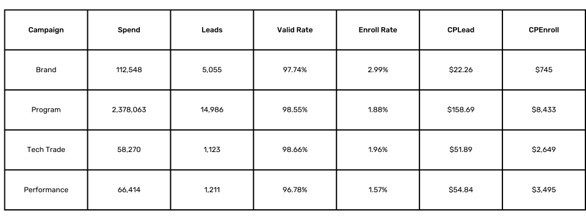
The documented action. Colling Media updated forms and CRM capture to retain click IDs, defined admissions milestones, and established nightly outcome exports to Google.
What the comparison showed. Performance Max had a lower lead-to-enrollment rate than program-specific campaigns, but its lower lead cost resulted in a 59% lower cost per enrollment in the published comparison.
The decision this evidence supports. Evaluate enrollment economics alongside lead volume and conversion rate. A lower enrollment rate alone does not establish that a campaign is less cost-effective.

Make your next marketing decision with clearer evidence
Contact us today to see how Colling Media’s Marketing Analytics and Technology Services can help you take control of your data and accelerate results!