

Your agency is obsessed with the bottom of the funnel. They celebrate low CPAs and high click-through rates on their performance campaigns, but they can’t explain why your overall growth has stalled. Sound familiar? It’s because they’re ignoring 90% of the customer journey. A staggering 79% of marketing leads never convert into sales, and it’s because most agencies are stuck in a silo, treating brand and performance as two separate disciplines. This isn’t just a flawed strategy; it’s a recipe for stagnation.
At Colling Media, we don’t see a funnel; we see a customer. We’ve built our entire agency around a proprietary, full-funnel framework called BDPN (Brand, Demand, Performance, Nurture). It’s not a buzzword; it’s our operating system. It’s how we build cohesive brand narratives that drive measurable results at every stage of the journey. This article will break down why the siloed agency model is broken and provide a blueprint for how we get it right, integrating brand and performance into a single, powerful growth engine.
The Great Divide: Why Most Agencies Stumble
The advertising world has long been characterized by a split personality. On one side, we have the traditional brand builders, masters of storytelling and emotional connection, who have historically relied on broad-reach channels like television to build brand equity. On the other, we have the performance marketers, the data-driven analysts who live and breathe metrics, optimizing campaigns for immediate, measurable results. This division, as highlighted in a report by McKinsey, has created a significant barrier to growth for many companies. [1]
The crux of the problem lies in the “measurement trap.” Performance marketing, with its easily quantifiable metrics, offers a seductive illusion of control and accountability. In contrast, the impact of brand-building efforts has traditionally been more challenging to measure, leading many to question its value. As one marketing executive confessed to McKinsey, “It’s tough to measure either the short-term or long-term impacts of brand campaigns…We attribute increases in sales to them because of correlation, not necessarily causation.” [1] This measurement disparity has led to a dangerous imbalance, with a disproportionate amount of marketing spend being allocated to bottom-of-the-funnel activities that capture existing demand, rather than creating it.
The consequences of this siloed approach are far-reaching. By neglecting the top of the funnel, agencies fail to build the emotional connection and brand loyalty that are crucial for long-term customer value. A customer who discovers a brand through a generic keyword search is far less likely to become a loyal advocate than one who has been nurtured through a series of engaging and informative touchpoints. This fragmented approach not only diminishes the customer experience but also leads to a significant loss of potential revenue and market share.
Deconstructing the Funnel: A Stage-by-Stage Guide
A successful full-funnel strategy requires a deep understanding of each stage of the customer journey. It’s about delivering the right message to the right person at the right time. As AdRoll aptly puts it, “The content you create follows the shape of this funnel: broad to start, then more focused at the bottom.” [2] Let’s break down the funnel into its core components:
Top of the Funnel (ToFu): Awareness
At the top of the funnel, the primary goal is to generate brand awareness and attract a broad audience. This is the stage where potential customers are just beginning to identify a problem or a need. The content at this stage should be educational and informative, not salesy. Think blog posts, articles, infographics, and social media content that address common pain points and answer frequently asked questions. The key metrics to track at this stage include reach, impressions, website traffic, and social engagement.
Middle of the Funnel (MoFu): Consideration
Once you’ve captured the attention of your audience, the next step is to nurture them through the consideration stage. At this point, potential customers are actively researching solutions to their problems. This is where you can start to introduce your brand as a viable option. Tactics like webinars, case studies, email newsletters, and retargeting campaigns are highly effective at this stage. The goal is to build trust and credibility, positioning your brand as an expert in the field. Key metrics for the middle of the funnel include lead magnet downloads, webinar sign-ups, and email open and click-through rates.
Bottom of the Funnel (BoFu): Conversion
The bottom of the funnel is where the magic happens. This is the decision stage, where potential customers are ready to make a purchase. The content at this stage should be highly targeted and persuasive, designed to overcome any final objections and close the deal. Free trials, demos, special offers, and customer testimonials are all powerful tools for driving conversions. The most important metrics to track at this stage are conversion rate, cost per acquisition (CPA), and return on ad spend (ROAS).
Beyond the Funnel: Retention & Advocacy
The customer journey doesn’t end with a conversion. The most successful brands understand the importance of customer retention and advocacy. This is where you can turn one-time buyers into lifelong fans. Loyalty programs, exceptional customer support, personalized communication, and referral programs are all effective strategies for fostering customer loyalty. By delighting your existing customers, you can create a powerful army of brand advocates who will spread the word and drive new business. Key metrics for this stage include customer lifetime value (CLV), churn rate, and Net Promoter Score (NPS).
The Fix: A Blueprint for a Successful Full-Funnel Strategy
Understanding the funnel is one thing; implementing a successful full-funnel strategy is another. It requires a fundamental shift in mindset, a commitment to integration, and a willingness to embrace new technologies and measurement methodologies. Here’s a blueprint for fixing the broken agency model and building a full-funnel strategy that drives sustainable growth:
1. Integrated Measurement: Beyond Last-Click Attribution
The first step is to break free from the tyranny of last-click attribution. This outdated model, which gives all the credit to the final touchpoint before a conversion, provides a distorted view of the customer journey. Instead, agencies need to adopt a more sophisticated and holistic approach to measurement. This includes:
- Brand Lift Studies: These surveys, often conducted on digital platforms, allow marketers to measure the impact of their campaigns on key upper-funnel metrics like brand awareness and favorability. [1]
- Attribution Modeling: Advanced attribution models, such as multi-touch attribution, provide a more accurate picture of how different channels and touchpoints contribute to conversions.
- Customer Journey Analytics: By tracking customer interactions across all touchpoints, from the initial ad impression to the final purchase, agencies can gain a deeper understanding of the customer journey and identify opportunities for optimization.
2. Unified Teams & Goals: Breaking Down the Silos
A successful full-funnel strategy requires a unified team with shared goals. The artificial divide between brand and performance marketing teams must be dismantled. Instead, agencies should create cross-functional teams that are responsible for the entire customer journey. This means establishing shared KPIs that align with overall business objectives, such as customer lifetime value and market share, rather than narrow, channel-specific metrics.
3. Content & Creative Synergy: A Cohesive Brand Narrative
Content is the fuel that powers the full-funnel engine. A successful strategy requires a cohesive content plan that maps to each stage of the customer journey. This means creating a variety of content formats, from educational blog posts and engaging social media content to persuasive case studies and compelling customer testimonials. It also means ensuring that the messaging and branding are consistent across all touchpoints, creating a seamless and unified customer experience.
4. Leverage Technology: Personalization at Scale
In today’s digital world, technology is a critical enabler of full-funnel marketing. Marketing automation and CRM platforms allow agencies to personalize the customer experience at scale, delivering the right message to the right person at the right time. AI and machine learning are also becoming increasingly important, enabling agencies to segment audiences, optimize campaigns, and predict customer behavior with unprecedented accuracy.
Stop Settling for a Fragmented Funnel
References
[1] Ader, J., Boudet, J., Brodherson, M., & Robinson, K. (2021, February 12). Why every business needs a full-funnel marketing strategy. McKinsey & Company. Retrieved from https://www.mckinsey.com/capabilities/growth-marketing-and-sales/our-insights/why-every-business-needs-a-full-funnel-marketing-strategy
[2] Henrie, S. (2024, June 24). What is a Full-Funnel Marketing Strategy? AdRoll. Retrieved from https://www.adroll.com/blog/what-is-full-funnel-marketing-strategy
Frequently Asked Questions About Full-Funnel Advertising
What is full-funnel advertising?
Full-funnel advertising is a strategic approach that addresses every stage of the customer journey, from initial brand awareness through consideration, conversion, and post-purchase nurturing. Rather than focusing solely on bottom-of-funnel tactics, it builds a cohesive system where each stage feeds the next.
Why do most agencies get full-funnel wrong?
Most agencies default to optimizing for the bottom of the funnel because it produces the most immediately measurable results. However, this approach starves the top of the funnel, leading to a shrinking pool of potential customers over time. True full-funnel requires the discipline to invest in brand and demand generation alongside performance marketing.
What is the BDPN framework?
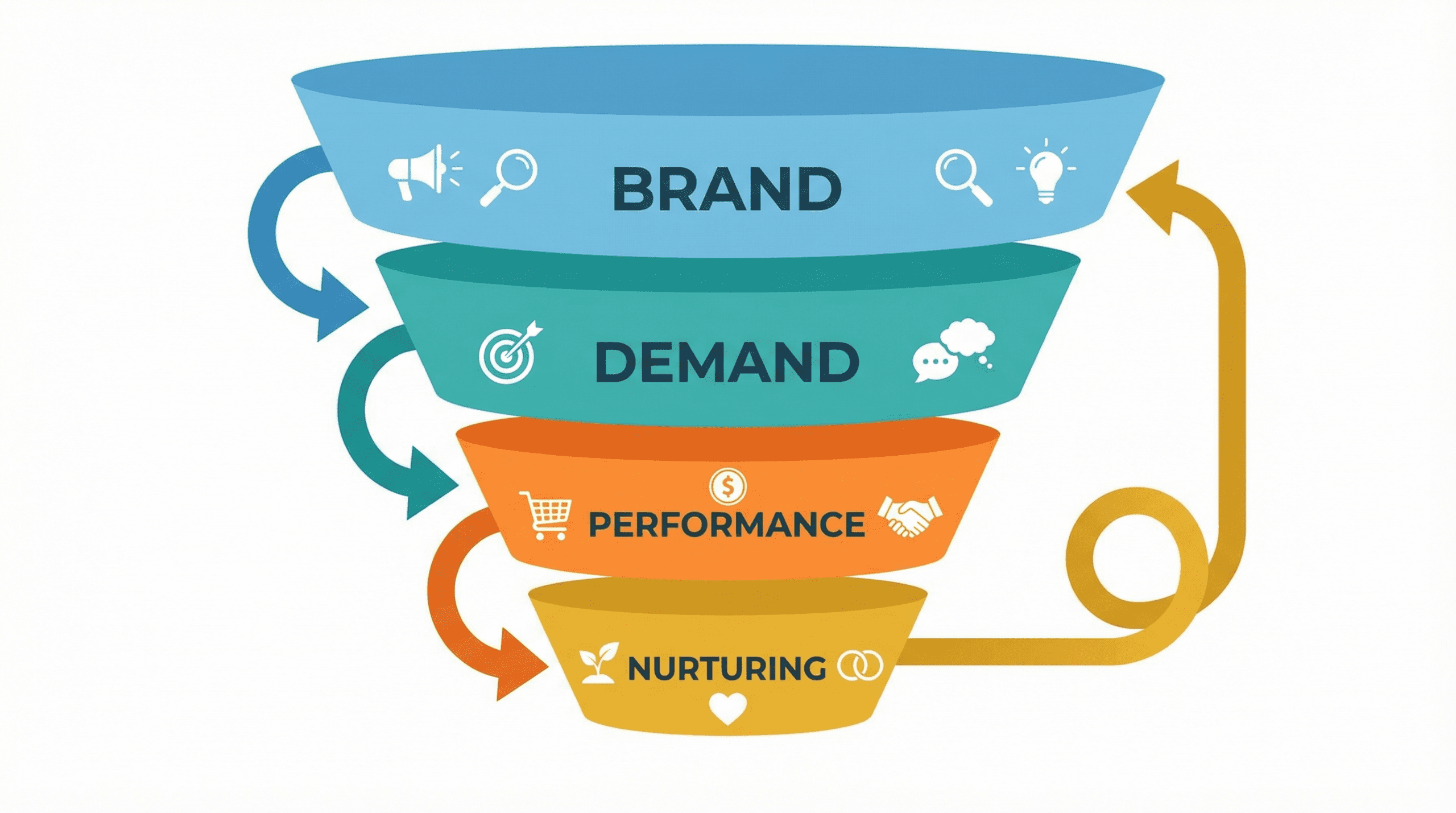
BDPN stands for Brand, Demand, Performance, and Nurturing. It is a strategic framework that ensures marketing investment is balanced across all four stages of the customer journey. Brand builds awareness, Demand generates interest, Performance drives conversions, and Nurturing retains and grows existing customers.
How do you measure full-funnel advertising success?
Full-funnel success requires different metrics at each stage: brand lift and reach at the top, engagement and consideration metrics in the middle, conversion rates and cost-per-acquisition at the bottom, and lifetime value and retention rates for nurturing. The key is connecting these metrics into a unified view of marketing performance.
How long does it take to see results from a full-funnel strategy?
Bottom-of-funnel results can be seen quickly, often within weeks. However, the full power of a full-funnel strategy typically becomes apparent over 3-6 months as brand awareness investments begin to lower acquisition costs and increase conversion rates across all channels.
Related Reading
About Colling Media
Colling Media is a full-service advertising agency headquartered in Phoenix, Arizona, specializing in Brand, Demand, Performance, and Nurturing (BDPN) strategies. With deep expertise in attribution, media buying, and data-driven marketing, Colling Media helps brands across industries including education, home services, transportation, and technology achieve measurable growth. Learn more at collingmedia.com.