

Credit Union Google Ads Case Study: 1,770 Conversions
The Challenge
Competing Against National Financial Institutions With a Regional Credit Union Advertising Budget
For regional credit unions, competing against national banks and fintech lenders presents a significant digital advertising challenge. Larger financial institutions have substantial media budgets, established brand recognition, and aggressive acquisition strategies. A regional credit union serving communities in the Midwest faced this competition across several important financial products, including auto loans, home equity lines of credit (HELOCs), mortgages, and certificates of deposit (CDs).
Its Google Ads campaigns competed for consumer attention alongside major financial advertisers, established regional banks, and other credit unions.
The competitive environment was particularly challenging. According to WordStream’s 2026 Google Ads Benchmarks, Finance and Insurance had the lowest average conversion rate among 23 measured industries, at just 2.64%.
The credit union needed to do more than generate website traffic or consumer interest. It needed to convert high-intent searches into measurable business opportunities while maximizing the efficiency of its advertising investment.
The challenge: Compete against much larger financial advertisers while generating more submitted applications and account openings not simply more clicks, page views, or website interactions.
The Strategy
Focus on Consumer Intent. Measure What Matters.
Colling Media developed a Google Ads strategy centered on connecting consumers actively researching financial products with the credit union’s relevant lending and deposit offerings.
Rather than building campaigns around general financial services traffic, the approach focused on product-level targeting, local consumer demand, and meaningful conversion measurement.
The strategy included four key components:
Organize Campaigns Around Financial Products
Colling Media structured campaigns around individual lending and deposit products, including auto loans, HELOCs, mortgages, CDs, money market accounts, credit cards, and RV loans.
This approach allowed campaign budgets, messaging, and landing pages to align with the credit union’s specific business priorities while reaching consumers searching for those products.
Coordinate Google Search and Performance Max
Google Search campaigns focused on capturing consumers actively researching financial products, comparing rates, and evaluating lending or deposit options.
Performance Max supported additional demand capture and reengagement across Google’s advertising inventory.
Together, the campaigns provided multiple opportunities to reach consumers throughout their financial decision-making process.
Prioritize Applications and Account Openings Over Surface-Level Metrics
A critical part of the strategy was distinguishing meaningful conversion activity from general website engagement.
Instead of treating every tracked website action as a conversion, Colling Media focused performance evaluation on two specific outcomes:
Submitted financial product applications
Account openings
Actions such as phone calls, button clicks, page views, and existing-member logins were excluded from the case study’s conversion totals.
This approach provided a more meaningful understanding of advertising performance and acquisition efficiency.
Use Competitive Intelligence to Identify Opportunities
Colling Media analyzed Google Ads auction insights and search-term performance to better understand the competitive landscape.
The analysis identified opportunities among consumers already researching competing financial institutions.
Campaign targeting also concentrated on local markets within the credit union’s service area, helping align advertising activity with geographic reach and consumer demand.
Credit Union Results
1,770 Applications and Account Openings in Just Over Nine Months
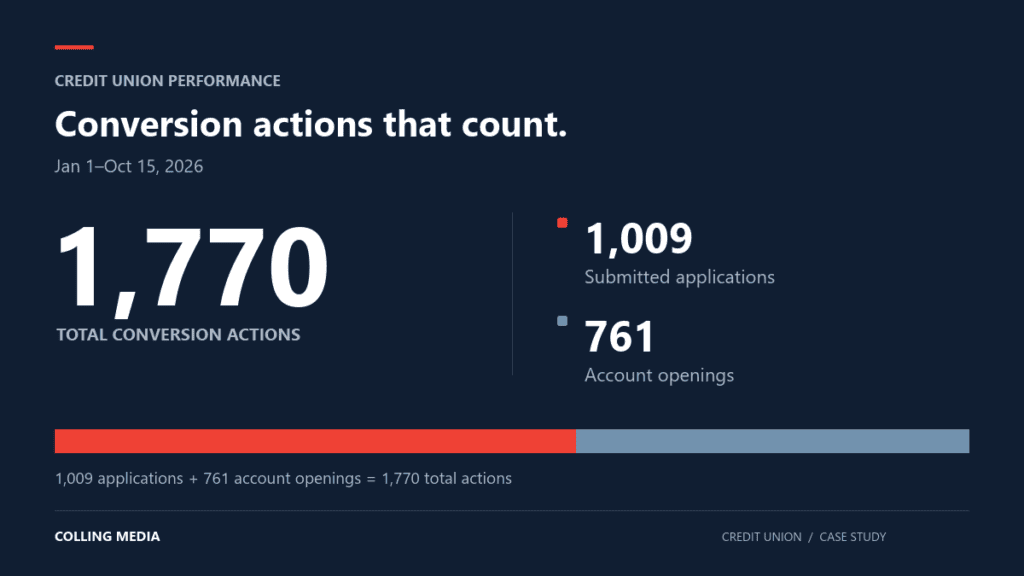
From January 1 through October 15, 2026, the credit union’s Google Ads program generated 1,770 submitted applications and account openings across its lending and deposit products, supported by $190,435 in media spend.
These results reflected meaningful consumer actions rather than general website activity.
Campaign Performance Highlights
| Performance metric | Credit union results | Industry benchmark |
|---|---|---|
| Submitted applications | 1,009 | — |
| Account openings | 761 | — |
| Total applications and account openings | 1,770 | — |
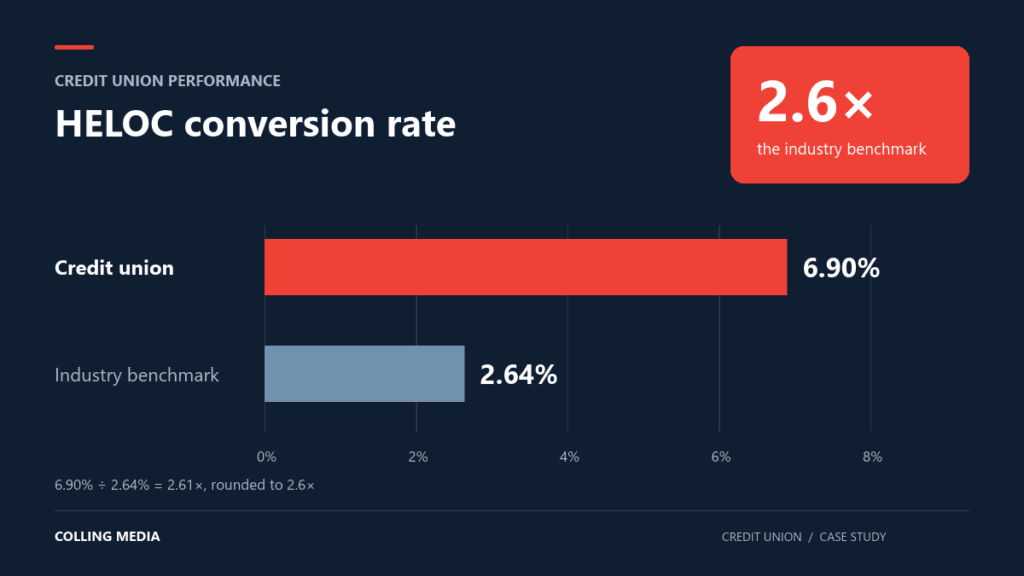
| HELOC Search conversion rate | 6.90% | 2.64% |
| CD Performance Max conversion rate | 4.80% | 2.64% |
| Performance Max cost per conversion | $39 | $74.44 cost per lead |
| CD Performance Max cost per conversion | $15 | $74.44 cost per lead |
| Average cost per click | $3.08 | $3.39 |
Industry figures represent Finance and Insurance Google Ads benchmarks from WordStream by LocaliQ. The industry cost-per-lead benchmark and the credit union’s cost per submitted application/account opening are different conversion measures and are presented for directional context.
HELOC Search Achieved a Conversion Rate 2.6 Times the Credit Union Industry Benchmark
The credit union’s HELOC Search campaigns achieved a 6.90% conversion rate, compared with the financial services industry benchmark of 2.64%.
This result demonstrated how product-specific targeting and high-intent search strategies could help a regional financial institution compete effectively against much larger advertisers.
The result was particularly meaningful because conversion measurement focused on submitted applications rather than softer engagement actions.
Performance Max Generated Application and Account Activity at Efficient Costs
Across Performance Max campaigns, the credit union achieved an average cost of $39 per application or account opening, numerically 48% below the industry’s $74.44 cost-per-lead benchmark.
CD Performance Max campaigns performed particularly well, generating applications and account openings at approximately $15 per conversion.
Performance Max also played an important role in capturing existing brand demand and reengaging interested consumers. Branded searches represented a substantial share of visible Performance Max conversions, so results should be viewed as a combination of demand capture and reengagement rather than exclusively new-customer acquisition.
Lower Average Cost Per Click
Across all campaigns, the credit union achieved an average cost per click of $3.08, compared with the industry benchmark of $3.39.
That represented approximately 9% lower click costs, helping efficiently attract prospective borrowers and deposit customers in a highly competitive advertising category.
Competitive Search Analysis Identified New Growth Opportunities
Beyond the immediate campaign results, competitive search analysis revealed an additional opportunity for future acquisition.
Consumers researching competing financial institutions showed meaningful application and account-opening intent.
Selected competitor-related search terms generated conversions at an observed cost of approximately $100 per application or account opening, creating a promising foundation for dedicated competitor-targeting campaigns.
These findings provided a data-informed opportunity to expand the credit union’s reach among consumers already evaluating alternative financial institutions.
Credit Union Case Study Conclusion
Better Targeting. More Meaningful Conversions. Stronger Competitive Positioning.
The credit union’s Google Ads results demonstrate how regional financial institutions can compete effectively against national advertisers without matching their advertising budgets.
By combining product-focused campaign architecture, high-intent search targeting, coordinated Performance Max campaigns, and meaningful conversion measurement, Colling Media helped the credit union generate 1,770 applications and account openings in just over nine months.
The HELOC Search conversion rate of 6.90% 2.6 times the financial services benchmark highlighted the effectiveness of reaching consumers with relevant products at the moment of intent.
Just as importantly, the campaign reinforced a critical performance marketing principle: advertising success should be measured by the customer actions that matter to the business, not simply by the number of interactions recorded.
For financial institutions competing in crowded markets, a more focused strategy can turn search demand into measurable business opportunities.
Source and methodology: Credit union Google Ads reporting, January 1–October 15, 2026. Conversion totals include submitted applications and account openings; they do not establish whether applications were approved or funded. Industry comparison data from WordStream by LocaliQ’s 2026 Google Ads Benchmarks, Finance and Insurance category, covering April 2025–March 2026. Conversion definitions, channel composition, and reporting periods are not identical.