

How to Spot Media Planning Mistakes Before They Hurt Results
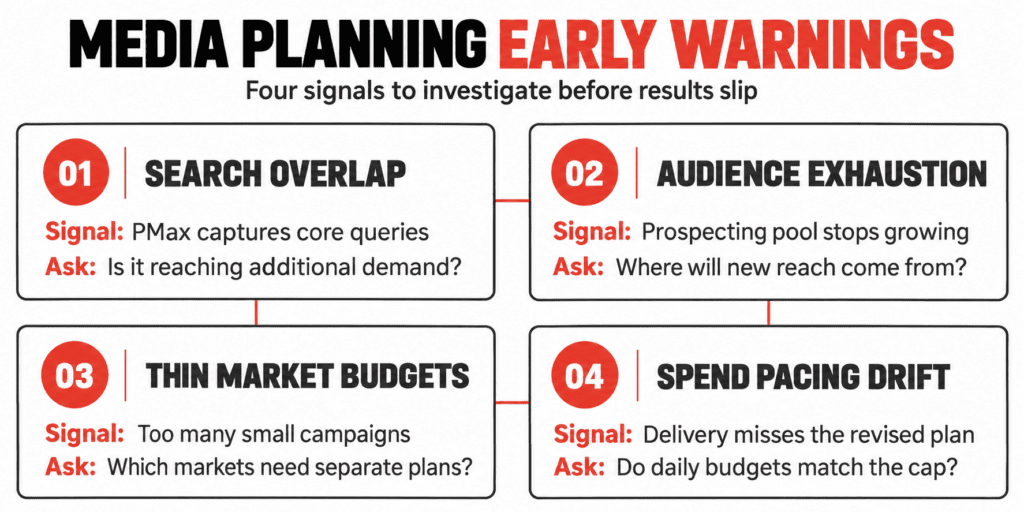
Media planning mistakes rarely announce themselves as a failed campaign. They first appear as small changes: an automated campaign captures searches another campaign was meant to own, an audience stops producing new prospects, a market has too little budget to learn, or a revised spending plan has not reached the people managing daily delivery.
Catching those signals early gives marketing teams more options than cutting spend after results decline. The key is to review whether the original plan still matches how campaigns are actually delivering, what the business needs, and what the budget can support.
Is each campaign doing the job you assigned it?
A channel can hit its conversion target while doing the wrong job in the media plan.
In one account review, an automated campaign was capturing branded and other high-intent searches that the team expected its Search campaigns to manage. Its reported conversions looked useful, but they did not establish whether the campaign was reaching additional demand. The planning question was whether the two campaign types had distinct roles.
A strong review compares the search terms and outcomes each campaign is receiving with the purpose assigned to it. If Search is intended to manage core high-intent demand, the team should examine whether Performance Max is contributing reach beyond that demand, and whether its creative assets and conversion signals support that goal.
This requires care. Google prioritizes an eligible Search campaign when a query is identical to one of its exact-match keywords, but campaign overlap can still occur outside that condition. Google also provides brand exclusions for advertisers who want to manage brand searches separately from Performance Max. Those controls should be evaluated against the account’s goals, rather than applied as a blanket rule.
The early warning sign is a campaign claiming success without demonstrating that it is fulfilling its assigned role. Ask: What demand is this campaign reaching that our other campaigns would not have captured in the same way?
What if cost per lead rises in Search?
A rising cost per lead is a reason to diagnose the change, not an automatic instruction to reduce the budget. Review which queries became more expensive, whether match types changed the mix of traffic, and whether ads and landing pages still answer those searches well.
In one review, the response to higher CPL included examining query controls and testing refreshed search ads in costly markets. The goal was to improve relevance before deciding whether the market deserved less investment.
Google identifies expected click-through rate, ad relevance, and landing page experience as components of its Quality Score diagnostic. That makes them useful places to investigate, although rewriting a responsive search ad does not guarantee a lower CPC or CPL.
Is your audience plan running out of room?
A prospecting campaign may weaken because the audience source that once supplied new people is exhausted. If delivery depends heavily on one third-party segment or a narrow pool of prospects, performance can deteriorate even when the ads and bids have not changed.
Watch whether the audience is still supplying sufficient eligible reach and whether new prospects are producing the intended downstream actions. When a source weakens, revisit how the audience was built, what other permitted signals are available, and whether the campaign has enough scale for its assigned role.
There is an additional planning question in regulated categories: Should this audience be used at all?
For housing advertising, a request to reach people more likely to pass an application process cannot simply be translated into a targeting filter. Nor should an advertiser assume that a lookalike audience built from existing applicants or residents is automatically a compliant solution. The U.S. Department of Housing and Urban Development warns that custom and mirrored audiences can reproduce limitations in their source lists and recommends examining both the lists and actual ad delivery for discriminatory effects. Audience changes in this setting need appropriate legal and platform-policy review before launch.
The wider lesson applies to any audience plan: a targeting idea must be both useful for the campaign and appropriate for the category. A larger or more precise-looking audience is not necessarily a better one.
Has the campaign structure divided the budget too thinly?
Geographic detail can help a media plan reflect genuine differences in demand. It can also create more campaigns than the budget can support.
In one multi-market review, small submarkets had been separated into campaigns with limited individual budgets. The team recommended consolidating some of them at the market level and revisiting the balance between prospecting and retargeting. Prospecting CPL later declined, although that change alone cannot establish which adjustment caused the improvement.
The early signal is not simply that a small market has a high CPA. Look for a pattern: limited delivery, too few meaningful outcomes to judge performance, and repeated budget adjustments across many small campaigns. Then ask whether those submarkets need distinct messages, inventory, business goals, or decisions. If they do not, a broader structure may give the team a clearer basis for optimization.
Consolidation should preserve differences that matter to the business. A market with a different offer, available inventory, or growth priority may still need its own plan. The purpose is to put enough budget behind each decision the team intends to make.
Does the spending plan still match the business plan?
Media budgets often change after campaigns launch. A spreadsheet is updated, a market cap shifts, or leadership revises a quarterly target. The planning mistake occurs when the change is not translated promptly into campaign-level pacing and ownership.
In one instance, a mid-month budget-sheet discrepancy created an overspend in a single market. The team identified it, communicated the issue, and recalculated the remaining daily spend across active campaigns to keep delivery within the overall market plan. That is a pacing correction. The earlier opportunity is a process that checks every budget revision against actual spend, remaining days, and campaign settings before the discrepancy grows.
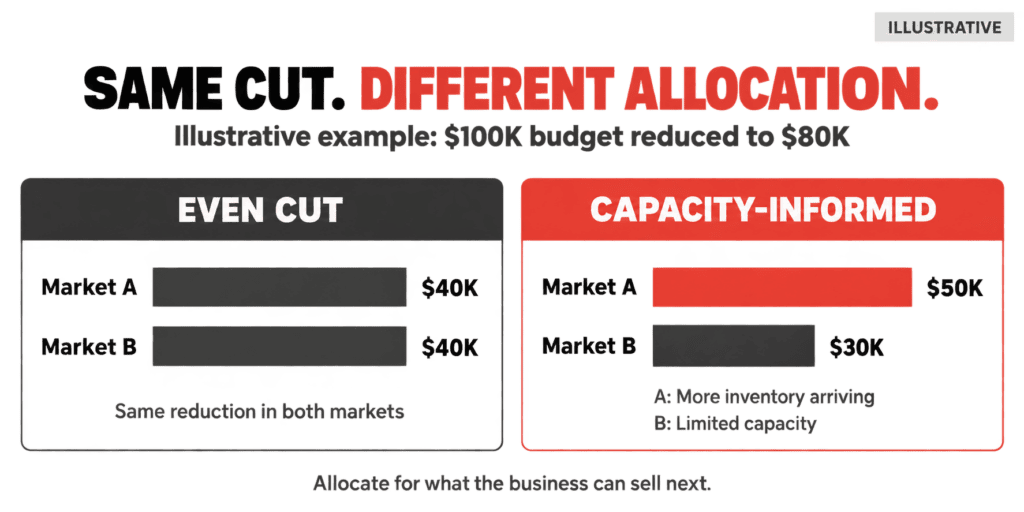
Budget reductions require the same discipline. When a business announces a future cut, dividing it evenly across markets or channels is simple, but it may be poorly matched to demand. If some markets have more product or capacity coming online soon, they may need a different allocation than markets with less to sell.
Before approving a cut, ask: What will the business need advertising to support over the next planning period, and what happens if we reduce this part of the plan? That question connects media allocation to inventory, timing, and expected customer demand instead of last month’s spending proportions.
How do you catch planning mistakes while there is still time to act?
A useful media review compares the plan, live delivery, and the next business decision.
The plan states the audience, channel role, market priority, budget, and outcome each campaign was designed to support. Live delivery shows which queries, audiences, placements, and markets are actually receiving investment. The decision names what should change, who owns it, and what evidence will show whether the change helped.
Those comparisons operate on different time scales. Pacing errors and incorrect campaign routing warrant prompt attention. Audience exhaustion and search overlap call for a closer diagnostic review. Larger shifts in market allocation should account for business forecasts and enough performance evidence to support a decision.
Colling Media’s BDPN framework helps clarify the job advertising is meant to do across Brand, Demand, Performance, and Nurture. The planning discipline is to check that campaigns continue to perform those assigned jobs as conditions change.
A media plan is most valuable when the team can challenge it early. If results are beginning to drift, Colling Media can help examine the planning decisions behind them before a small mismatch becomes a larger performance problem.