

Is Your Brand Showing Up in ChatGPT? How to Measure AI Search Visibility
Your next customer may be asking ChatGPT about businesses like yours. Here’s how to find out whether your brand is part of the answer.
Imagine a potential customer asking ChatGPT, “What’s the best digital advertising agency in Phoenix?”
Instead of scrolling through a page of traditional search results, that customer may receive an AI-generated answer comparing agencies, explaining their capabilities, and recommending businesses to consider.
Your company might be among them.
Or your competitors might get all the attention.
Here’s the question every business should be asking: Is your brand showing up in AI-generated answers, and how would you know?
As people increasingly use ChatGPT, Google AI Overviews, Perplexity, and Microsoft Copilot to research products, services, and businesses, brands have another important area of search visibility to understand.
And unlike what some businesses might assume, AI search visibility isn’t entirely a guessing game.
It can be measured.
How Do You Know If Your Brand Appears in ChatGPT?
Start by thinking about the questions potential customers ask before choosing a business like yours.
For example, imagine you operate a career training school in Phoenix.
A prospective student might ask ChatGPT, “What are the best trade schools in Phoenix for hands-on career training?”
Another might ask, “Which Phoenix trade schools offer flexible schedules for working adults?”
Someone comparing career options could ask, “What are the best alternatives to a four-year college in Arizona?”
Now look at the answers.
Does your school appear? Which competing schools are mentioned? How are those schools described? Are any websites cited as sources?
These questions can provide an initial look at how your brand appears in AI-generated responses.
But there’s an important distinction.
One ChatGPT answer is a snapshot. Consistent monitoring reveals the pattern.
AI-generated responses can vary depending on the platform, wording of the question, available sources, location, and other factors.
That’s why measuring AI search visibility requires more than occasionally asking ChatGPT about your business.
What Should You Measure in AI Search?
Traditional Search Engine Optimization (SEO) tracks metrics such as keyword rankings, impressions, organic traffic, and conversions.
AI-powered search introduces additional measurements that help businesses understand whether they’re appearing in AI-generated answers and how they compare with competitors.
Brand Coverage: How Often Does20Your Business Appear?
Brand coverage measures how frequently your business appears across a defined set of monitored AI search responses.
For example, if you monitor 40 relevant questions and your business appears in 12 responses, your observed brand coverage is 30%.
That doesn’t mean 30% of all ChatGPT users see your business. It means your brand appeared in 30% of the specific responses measured.
This distinction matters because AI search visibility isn’t a universal ranking. It’s a measurement of how frequently a brand appears within a selected group of questions and platforms.
Monitoring brand coverage over time helps businesses establish a baseline and identify meaningful changes.
Competitive Visibility: Who Is Showing Up Instead?
Knowing whether your brand appears is important.
Knowing which competitors appear is equally valuable.
If potential customers repeatedly ask AI platforms about your industry and competing businesses are mentioned more frequently, that raises important questions.
What information is available about those competitors? Are they being referenced in industry publications? Do their websites provide more comprehensive answers to customer questions?
Competitive visibility can uncover opportunities that traditional SEO rankings may not fully explain.
Brand Mentions vs. Website Citations
Two important measurements in AI search are brand mentions and website citations.
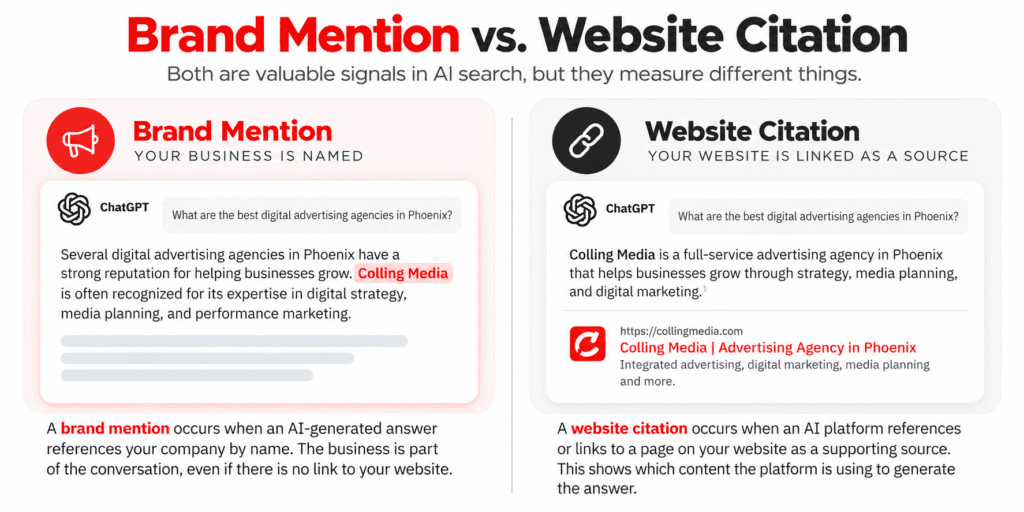
A brand mention occurs when an AI-generated answer references your business by name.
A website citation occurs when an AI platform references or links to a page on your website as a supporting source.
For example, ChatGPT might recommend an advertising agency without linking to its website.
In another response, it might cite an agency’s educational article about marketing strategy without directly recommending that agency.
Both provide valuable information, but they measure different things.
Brand mentions show whether your business is part of the conversation. Website citations help identify which content AI platforms reference when generating answers.
Brand Position and Accuracy
Simply appearing in an AI-generated response doesn’t tell the whole story.
Where does your business appear among the companies mentioned? Is it positioned prominently? Is the description accurate? Are its services and capabilities represented correctly?
An AI platform might mention your company but describe outdated services or overlook an important area of expertise.
Monitoring brand position, sentiment, and accuracy can help identify these issues and inform improvements to the information available about your business.
AI Referral Traffic
Visibility doesn’t always result in website traffic.
Someone may see your business mentioned in ChatGPT without ever visiting your website. Another person might click a citation or supporting link to learn more.
Where referral data is available, website analytics can help identify visits originating from AI-powered platforms.
Combining AI search visibility data with website analytics provides a more complete picture of how these experiences may contribute to business discovery.
Why One ChatGPT Search Isn’t Enough
AI-generated answers aren’t fixed rankings.
Ask the same question on different days and you may receive different businesses, descriptions, or citations.
In a September 2026 study, Otterly.AI analyzed 252,407 AI-generated answers across seven AI platforms.
The research found that brand mentions were generally more stable than citations. It also found that increasing the number of monitored prompts from 10 to 100 reduced variation in reported brand coverage by approximately 73% in the dataset studied.
The findings reinforce an important principle for marketers.
Don’t judge your AI search visibility by one answer. Measure a consistent set of relevant questions over time.
The goal isn’t to eliminate variability. It’s to understand normal fluctuations so meaningful trends become easier to identify.
How Colling Media Measures AI Search Visibility
At Colling Media, we believe marketing decisions should be guided by measurable information, not assumptions.
That’s why we’ve partnered with Otterly.AI, an AI search monitoring and optimization platform that helps businesses understand how their brands appear across AI-powered search experiences.
Otterly.AI provides insights into brand coverage, competitive visibility, website citations, and other indicators across major AI search platforms.
These capabilities help us understand where brands appear, how those appearances differ between platforms, and where opportunities may exist to strengthen visibility.
We’re also using the platform to measure our own brand.
A Look at Colling Media’s AI Search Visibility
Since October 1, 2026, Colling Media has monitored 15 non-branded search prompts covering a mix of our advertising services and prospective client personas.
These prompts run daily across ChatGPT, Google AI Overviews, Perplexity, and Microsoft Copilot.
The results reveal how differently AI platforms can represent the same business.
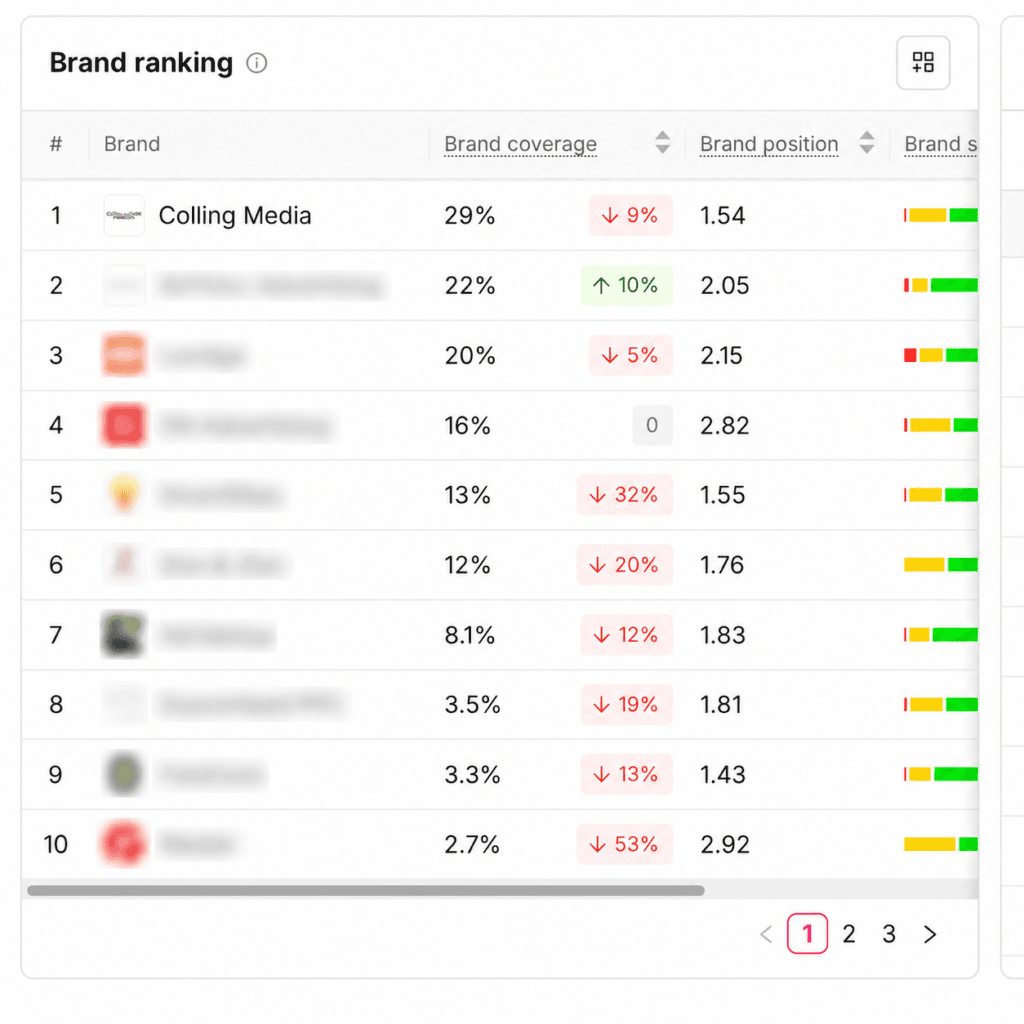
Colling Media’s AI search visibility dashboard in Otterly.AI, tracking brand coverage and competitive visibility across four AI-powered search platforms.
Colling Media Appears in 29% of Monitored AI Search Responses
Across our monitored AI platforms, Colling Media’s overall brand coverage is 29%.
But the individual platform results tell a much more interesting story.
Google AI Overviews shows our highest brand coverage at 53%. ChatGPT follows at 29%, Microsoft Copilot at 27%, and Perplexity at 12%.
That’s a 41-percentage-point difference between our highest and lowest observed brand coverage.
The takeaway: Strong visibility on one AI search platform doesn’t guarantee similar visibility on another.
A company could perform well in Google AI Overviews but have limited visibility in Perplexity. Another business might be mentioned consistently in ChatGPT but appear less frequently in other AI-generated answers.
For marketers, this means measuring a single AI platform may leave significant gaps in understanding overall search visibility.
How Does Colling Media Compare with Other Advertising Agencies?
Our monitoring also identifies competing advertising agencies appearing across the questions we’re tracking.
Within our monitored prompt set, one advertising agency has 22% brand coverage, followed by another at 20%, one at 16%, one at 13%, and one at 12%.
Colling Media’s 29% overall brand coverage exceeds that of these five tracked competitors.
While that’s an encouraging initial result, the context is important.
These percentages reflect appearances within our selected questions, platforms, and monitoring period. They don’t represent total market share or an industry-wide ranking of advertising agencies.
What makes the data useful is the ability to identify which agencies appear for particular services and customer questions.
That gives us information we can use to investigate potential content gaps, competitive positioning, and opportunities to strengthen our visibility.
What 291 Website Citations Tell Us
Our Otterly.AI monitoring has also identified 291 citations involving 26 unique Colling Media website URLs.
Those numbers offer another perspective on how our website content appears in AI-generated answers.
Beyond understanding whether Colling Media is mentioned, citation data helps us identify which pages are being referenced and which topics are associated with those appearances.
This can inform decisions about future content development, technical SEO, internal linking, and digital PR.
Citations don’t automatically translate into traffic, leads, or business results. But they offer useful insight into how our website is being referenced within the monitored AI search experiences.
One Question. Four AI Platforms. Very Different Answers.
Perhaps the most revealing finding from our monitoring involves a single question:
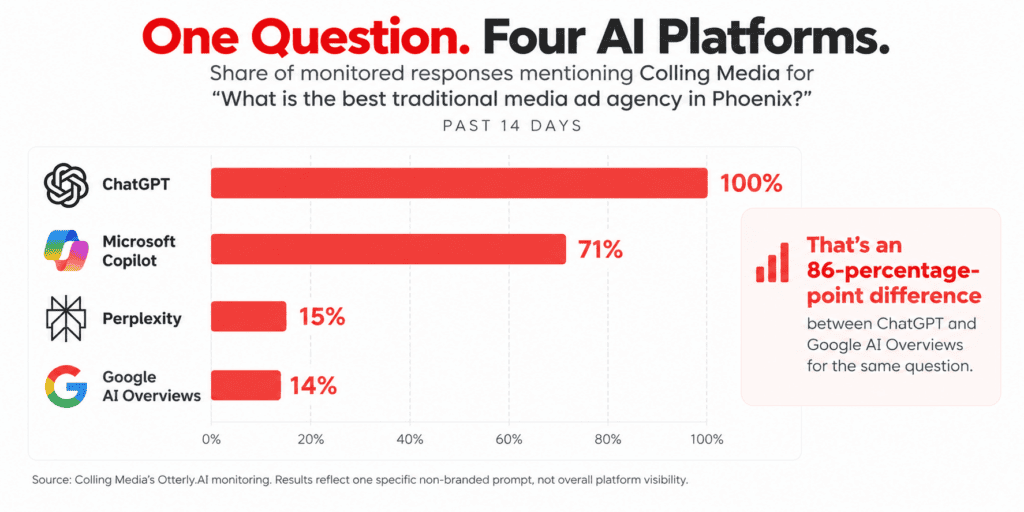
“What is the best traditional media ad agency in Phoenix?”
Over the past 14 days, Colling Media has appeared in 100% of monitored ChatGPT responses to that question.
For the exact same question, Microsoft Copilot mentioned Colling Media in 71% of monitored responses.
Perplexity mentioned us in 15%.
Google AI Overviews mentioned us in just 14%.
That’s an 86-percentage-point difference between ChatGPT and Google AI Overviews.
Think about what that means for a business evaluating its search visibility.
If we only monitored ChatGPT, we might conclude that Colling Media has excellent visibility for traditional media advertising in Phoenix.
But looking across multiple platforms reveals a very different picture.
The business is highly visible for that question on one platform and much less visible on others.
This is why AI search monitoring needs to account for the individual platforms, not just an overall visibility score.
It’s also why brands need to pay attention to how they’re mentioned, where they appear, what sources are cited, and how those signals change over time.
The real opportunity isn’t simply to appear in AI search. It’s to understand where your brand appears, where it doesn’t, and what might explain the difference.
How Can You Improve Your Brand’s AI Search Visibility?
Measuring visibility is the starting point.
The next step is deciding what can be improved.
Generative Engine Optimization (GEO) focuses on improving opportunities for brands to be discovered, mentioned, and accurately represented in AI-generated answers.
GEO doesn’t replace traditional SEO. It extends the way marketers evaluate discoverability across an evolving search landscape.
While no business can guarantee placement in ChatGPT or other AI-generated responses, established marketing practices can support both traditional and AI search visibility.
Answer the Questions Your Customers Actually Ask
Your website should provide helpful, direct answers to the questions potential customers ask before making a decision.
That means thinking beyond short keyword phrases.
Consider the comparisons customers make, the problems they’re trying to solve, the services they need, and the factors influencing their decisions.
Content that clearly addresses these questions creates value for customers and gives search platforms useful information to discover and reference.
Make Your Website Easy to Understand
Technical SEO remains an important foundation.
Clear page structures, descriptive headings, relevant internal links, accessible content, and accurate business information help search engines discover and understand your website.
Good technical practices also support the broader digital experience.
Build Authority Beyond Your Own Website
AI-powered search can draw on information from sources beyond a business’s website.
Industry publications, credible third-party coverage, research, and other authoritative sources may contribute information referenced in AI-generated answers.
That’s one reason digital PR and content marketing can play an important role in an integrated search strategy.
Building credible visibility beyond your own website helps strengthen your broader digital presence.
Publish Original, Useful Information
Publishing more content isn’t automatically better.
Original case studies, useful industry research, expert insights, and practical educational resources give potential customers meaningful reasons to engage with your business.
For example, Colling Media’s own AI search visibility monitoring provides a real-world illustration of how differently brands may appear across AI platforms.
Original information like this can offer value beyond content that simply summarizes existing marketing advice.
Monitor, Learn, and Adjust
AI search visibility isn’t a one-time project.
Businesses should establish a baseline, monitor important questions consistently, evaluate competitive visibility, and review changes over time.
Those insights can help prioritize improvements to content, SEO, digital PR, and broader brand positioning.
The objective is to connect visibility measurements to actionable marketing decisions and, where possible, measurable business outcomes.
SEO and GEO: Why Businesses Need Both
Does the growth of AI-powered search mean traditional SEO is becoming obsolete?
No.
Google’s guidance on AI search features reinforces that fundamental SEO best practices remain relevant to AI Overviews and AI Mode.
The difference is that businesses now need to think about more than traditional search engine rankings.
SEO helps businesses improve their visibility in organic search results.
GEO expands the focus to AI-generated answers, where platforms may summarize information, compare companies, and cite supporting sources.
For marketers, the opportunity isn’t to choose between SEO and GEO.
It’s to build a search strategy that helps customers discover, understand, and evaluate your brand wherever they’re looking for answers.
At Colling Media, that means connecting SEO, content strategy, digital PR, analytics, and AI search monitoring rather than treating them as unrelated activities.