

Why Your Ads Generate Leads but Not Sales
Your advertising is producing inquiries. The dashboard shows conversions. Your cost per lead looks reasonable. But the sales, enrollments, or booked jobs you expected are not following.
When ads generate leads but not sales, the problem can involve lead quality, follow-up, the offer, purchase timing, or incomplete tracking. Finding the right fix starts with identifying where valid prospects stop moving toward becoming customers.
At Colling Media, we believe the most useful question comes after the conversion report: What happened to the people who inquired?
That answer should guide what you change in your advertising, your lead-handling process, and your next budget decision.
Are your campaigns counting the right conversions?
Before judging lead quality, confirm what your advertising platforms count as a successful conversion.
A button click, a completed form, a connected phone call, and a qualified opportunity represent different levels of progress. If they appear together in a conversion total without clear distinctions, the report can suggest more commercial activity than the business is experiencing.
Start by comparing the platform’s conversion actions with actual inquiry records. Check whether forms create usable leads, calls represent genuine conversations, and duplicate events inflate the totals.
Then agree on what qualifies a lead. Marketing, sales, and leadership should share a definition that reflects the business. Depending on the organization, that might involve service eligibility, location, demonstrated need, purchase timing, or an agreed next step.
A reliable diagnosis requires both a clear definition and a record of what happened.
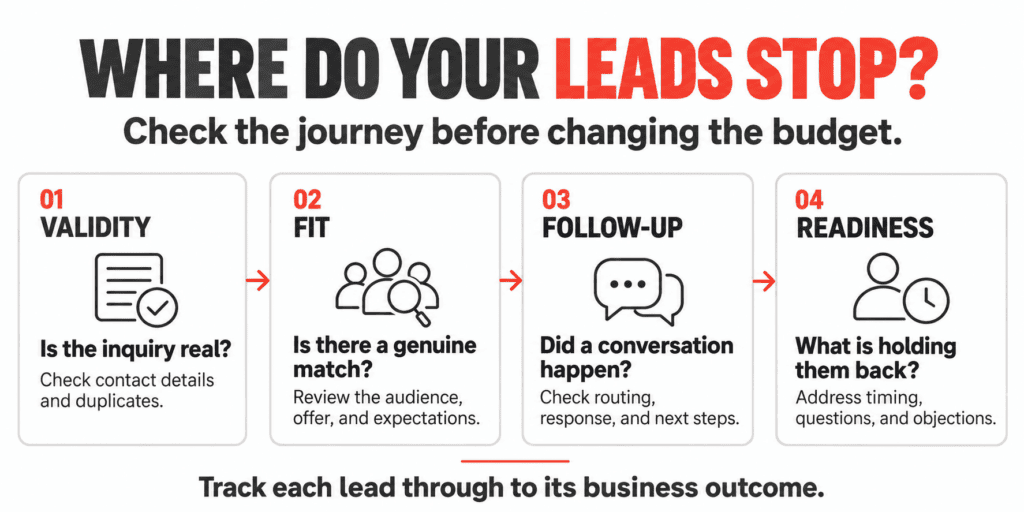
Are the leads invalid, a poor fit, or simply not ready?
“Bad leads” often becomes a label for several different problems.
An invalid lead may contain fabricated contact details, spam, or a duplicate submission. That points toward verification and tracking issues.
A poor-fit lead is a real person whose needs do not match the business. Repeated inquiries for an unavailable service, an unsupported location, or a misunderstood offer suggest that targeting, messaging, or the landing page needs attention.
A future buyer may be a good fit but unable to act yet. That person may need more information, a later start date, or time to compare alternatives.
These distinctions matter because they require different responses. Verification can reduce invalid inquiries. Clearer advertising can set better expectations. Relevant follow-up can help interested prospects progress.
Review a recent sample of inquiries and record why each did or did not advance. Group the reasons by source, campaign, offer, and market where possible. The resulting pattern is more useful than a general complaint that lead quality has declined.
Where are qualified prospects dropping out?
Once you identify genuine, relevant inquiries, examine their path through the business.
Were they contacted? Did a conversation occur? Was an appointment booked and attended? Did a proposal, application, or other next step follow? What reason was recorded when the opportunity ended?
An unanswered call does not establish that someone was unqualified. A qualified prospect who could not find a suitable appointment may represent a capacity problem. A person who expected something different from the offer may reveal a messaging problem.
Look at response timing, contact attempts, routing, availability, and recorded outcomes together. Compare sources under reasonably similar handling conditions. If one campaign’s leads receive prompt attention while another source waits in an inbox, their conversion rates do not provide a clean comparison of advertising quality.
Have the leads had enough time to convert?
Evaluate lead sources over a period that reflects your sales cycle.
A campaign launched recently may appear weak because its prospects are still considering their options. Comparing those leads with a mature group that has had several months to purchase can create a misleading conclusion.
Group leads by when they entered the pipeline, then compare their progress at similar ages. For a longer sales cycle, qualified conversations or appointments may provide an earlier signal while completed sales accumulate.
This helps distinguish a source that is underperforming from one whose results are still developing.
Can a lower-converting lead source still deliver better results?
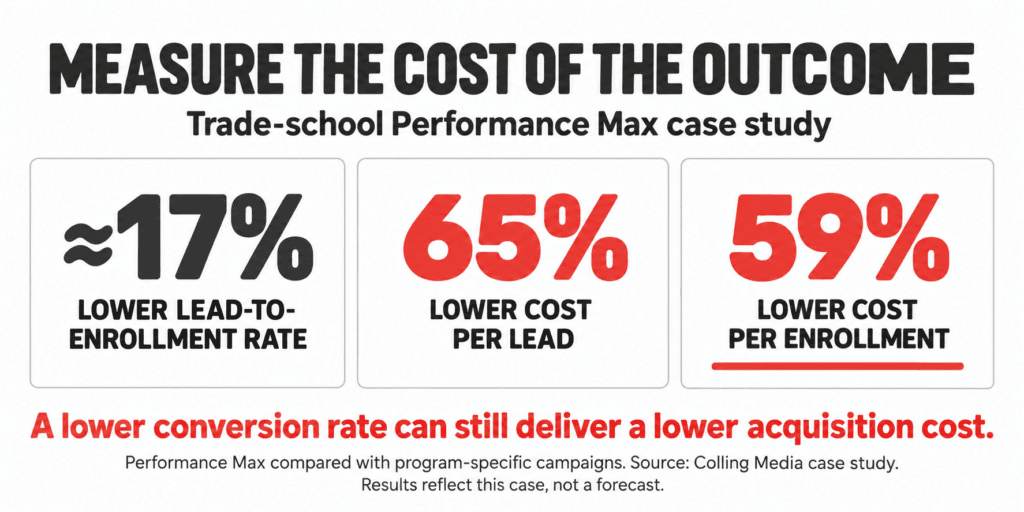
Yes. Lead-to-sale conversion rate describes one part of the economics. The cost of acquiring those leads also matters.
In a published Colling Media Performance Max case study, a trade school’s Performance Max leads had an approximately 17% lower lead-to-enrollment rate than program-specific campaigns. However, their cost per lead was 65% lower, producing a 59% lower cost per enrollment in that comparison. Colling Media
Judging that source only by its enrollment rate would have missed its acquisition efficiency.
For comparable lead groups, the relationship is straightforward:
Media cost per customer = cost per lead ÷ lead-to-customer conversion rate.
Use the conversion rate as a decimal in that calculation. Also keep the cost definition consistent: media cost per customer excludes agency fees, sales labor, and other acquisition expenses unless you explicitly include them.
The practical question is whether a lead source produces enough valuable customers at an acceptable total cost. A source that generates more inquiries may also require more staff time to qualify them. Customer revenue, margin, retention, and operational capacity can all affect whether its apparent efficiency is commercially worthwhile.
Lead quality should help explain business value. It should not become a score detached from acquisition economics.
Do your advertising platforms know which leads become customers?
A campaign’s optimization can be limited by the outcomes it receives.
If the only recorded success is a form submission, the platform has limited information about which inquiries later qualified, attended an appointment, or purchased.
In the trade-school case study, Colling Media connected lead records with advertising identifiers and sent later milestones back to Google, including qualification, campus visits, and enrollment. That created a feedback loop between the campaign and the outcomes the institution needed. Colling Media
Google’s current guidance supports choosing meaningful lead-generation goals and connecting first-party data with advertising measurement. It also emphasizes conversion volume, freshness, and delay when selecting an optimization goal. Google Ads Help
The appropriate milestone depends on your business. A qualified opportunity may be a useful signal when completed sales are infrequent or take months to occur. A completed purchase may be practical when outcomes arrive consistently and promptly.
Before changing bidding goals, verify that the data is accurate, consistently classified, permitted for the intended use, and reaching the platform reliably. Connecting a CRM is valuable when the underlying records support a trustworthy decision.
Could your next customers already be in your database?
Some inquiries need continued communication before they are ready to act.
When the business responds by purchasing more leads, it can overlook people who have already expressed interest. Examine whether those prospects receive relevant information after the first contact and whether their circumstances have changed.
In a published Colling Media nurturing case study, an education advertiser re-engaged unconverted inquiries with advertising featuring student testimonials and reasons to enroll. The campaign reached 82% of the eligible group, with 18% held out as a control.
The published case reports 150 additional enrollments compared with the control, supported by $22,000 in media spend, before additional fees. It also reports a cost per enrollment 81.75% lower than the advertiser’s best alternative acquisition source. These were results from that specific campaign and comparison. collingmedia.com
The lesson is to investigate why interested prospects paused. Nurturing should address the questions or obstacles that remain, such as confidence, timing, requirements, or the next step.
This is the Nurture stage of Colling Media’s Brand, Demand, Performance, and Nurture framework. The customer journey continues after an inquiry, and the media plan should account for that progression.
What should you fix before increasing your advertising budget?
Begin with a recent group of leads that has had sufficient time to progress. Follow those records from the original inquiry through contact, qualification, and the latest outcome.
Validate that the inquiries and conversion counts are real. Then examine fit and expectations. Review whether relevant prospects received consistent handling, whether they had enough time to act, and whether the offer met their needs.
Calculate acquisition costs for sources whose data is mature enough to compare. Finally, check whether meaningful downstream outcomes inform campaign reporting and optimization.
That sequence turns a broad complaint into a specific decision.
If inquiries repeatedly come from unsupported locations, investigate targeting and message clarity. If relevant prospects remain uncontacted, address routing and follow-up. If many qualified people pause over the same unanswered question, improve the content they receive. If a source delivers customers efficiently despite a lower conversion rate, assess its economics before reducing investment.
Choose a correction, assign an owner, and define what improvement would justify keeping the change. The objective is to resolve the largest evidenced constraint while maintaining a clear record of what was tested.
What should you expect from your advertising agency?
Your agency should be able to explain what happens beyond the lead count.
That includes which sources produce qualified opportunities, where prospects stop progressing, what data is missing, and how those findings affect advertising decisions. Where sales or admissions information is unavailable, the agency should explain what remains uncertain and help establish the feedback needed to improve the analysis.
Colling Media connects advertising strategy with analytics, conversion tracking, and CRM integration to help businesses understand those relationships.
If your advertising is generating inquiries without enough customers, talk with our team about reviewing the path from lead to outcome. A clearer understanding of that path can reveal where your next improvement should happen.