

When Should You Refresh Your Ad Creative?
Refresh your ad creative when evidence suggests the execution or message is losing effectiveness, when the offer changes, or when the audience needs different information to move forward. The age of an ad alone is not a reliable reason to replace it.
For marketing leaders, the challenge is deciding what actually needs to change. A campaign’s rising acquisition cost could justify a new opening, a different reason to believe, or an entirely new creative concept. It could also point to an audience, offer, or website problem.
At Colling Media, we recommend starting every creative refresh with a specific question: What do we expect the new creative to improve, and what evidence supports that expectation?
That question connects production decisions to business performance and gives the team a useful way to judge the work.
What is creative fatigue?
Creative fatigue is a decline in an ad’s effectiveness associated with repeated exposure to the same execution or message.
The important distinction is between seeing an ad repeatedly and responding to it less effectively. Repetition alone does not establish fatigue. An audience may continue seeing an ad while qualified inquiries, purchases, or other intended outcomes remain healthy.
A diagnosis therefore needs more than an impression count or a feeling that the campaign has been running too long. Look for a meaningful change in response, then investigate whether repeated exposure is a plausible explanation.
Creative fatigue is a working hypothesis to test. It should not become the default explanation for every performance decline.
What signals suggest your ad creative needs attention?
Look for patterns across attention, response, and business outcomes.
An ad may attract fewer relevant clicks, lose viewers earlier in a video, or generate fewer qualified actions relative to its delivery. Those changes become more informative when they persist across a useful comparison period and appear within reasonably similar audiences and placements.
Compare the ad with its own history and with other creative serving under similar conditions. Check whether the audience mix, budget, offer, or landing experience changed during the same period.
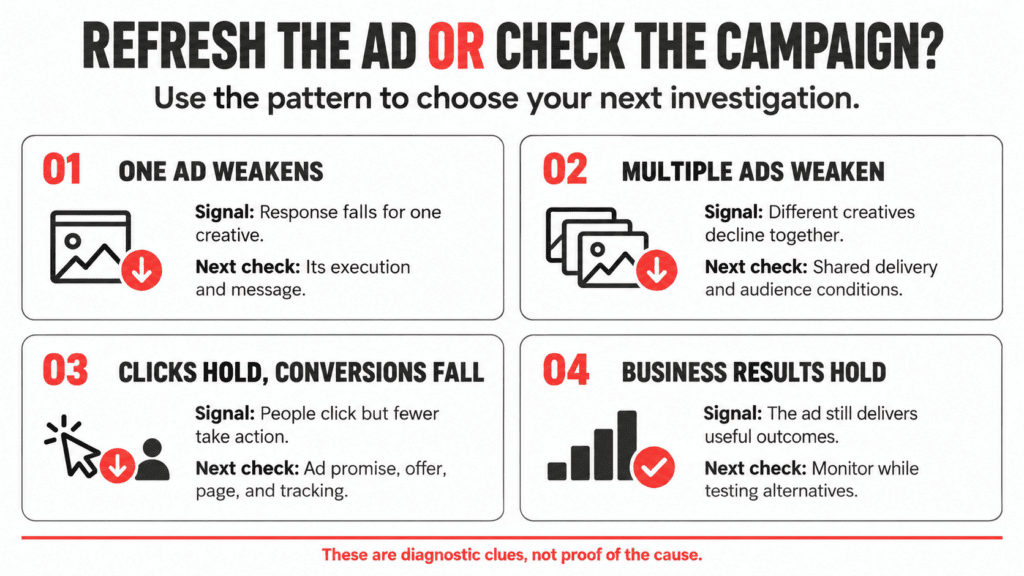
A decline concentrated in one creative gives you a reason to investigate that asset. A decline across several different ads gives you a reason to examine shared conditions as well. Neither pattern proves the cause by itself.
The goal is to identify the next sensible test before commissioning more production.
Does rising frequency mean it is time for a refresh?
Rising frequency tells you people are receiving more exposures on average. It does not tell you whether those exposures are helping or hurting the campaign.
Interpret frequency alongside reach, response, conversion quality, and the campaign’s role. Retargeting a small group of interested prospects creates a different exposure pattern from reaching new customers across a large market.
There is no single frequency threshold that should trigger a refresh across every audience, platform, and business. A useful review asks whether increased exposure is accompanied by weaker results and whether the campaign still has room to reach relevant people.
Could the problem be somewhere else in the campaign?
Before replacing creative, follow the customer’s path from impression to outcome.
If advertising costs rise while response rates remain similar, examine changes in auction conditions, placement mix, and delivery. If people still click but fewer complete the next step, examine the offer, landing page, form, availability, and tracking.
If inquiries continue but fewer become customers, look beyond the ad. Colling Media’s guide to why ads generate leads but not sales explains how qualification, follow-up, purchase timing, and measurement can affect the outcome.
These patterns provide directions for investigation. They should not be treated as automatic rules. An ad can generate clicks by setting the wrong expectation, so a post-click problem may still involve the message.
Review the ad and the destination together. Does the page deliver the offer the ad appears to promise? Does it answer the question that motivated the click? Can the business provide what the customer expects?
A new image will have limited value if that underlying mismatch remains.
Should you refresh the execution or rethink the message?
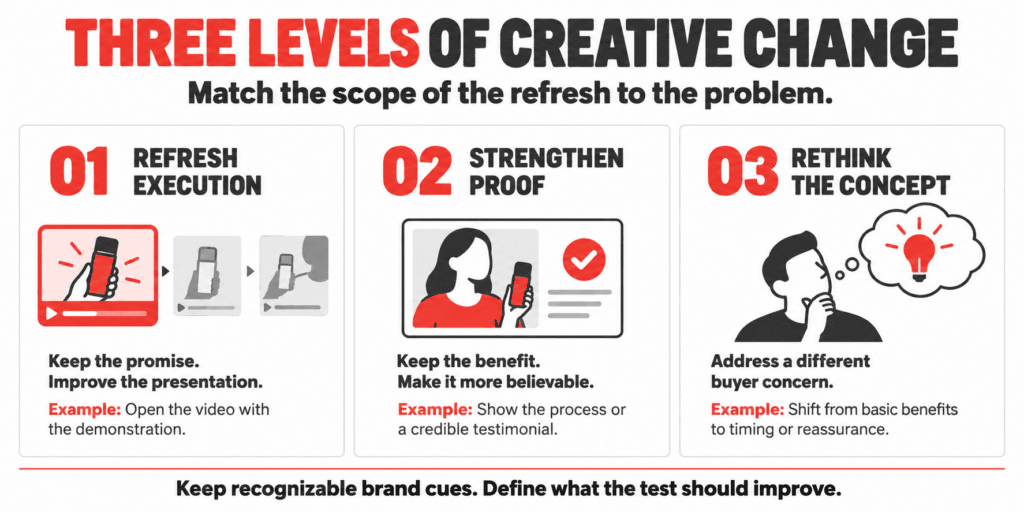
The scope of a creative change should match the problem you are trying to solve.
Refresh the execution when the idea still appears useful
An execution refresh preserves the central promise while changing how the audience encounters it.
That could mean opening a video with the demonstration instead of an introduction, making the benefit easier to read, improving captions, or adapting a layout to its placement.
For example, an advertiser may have useful footage demonstrating a service, but the first several seconds do little to explain why someone should watch. A new opening tests the presentation of the idea without requiring the team to abandon the entire concept.
The brief should state what the revised execution is expected to improve.
Change the proof when the audience needs reassurance
Sometimes the benefit is clear, but the audience needs a stronger reason to believe it.
A testimonial, demonstration, comparison, or explanation of the process may address uncertainty more effectively than another version of the original claim.
Consider a prospective student evaluating hands-on training. An ad that promises practical learning communicates a benefit. Footage showing the equipment, instructor interaction, and a typical classroom activity gives that promise substance.
This changes the evidence supporting the message. It can be accomplished while preserving recognizable branding and the central benefit.
Rethink the concept when the buyer’s concern has changed
A concept change introduces a different strategic idea: another problem to solve, motivation to address, or reason to choose the business.
An audience that already understands the basic offer may need help evaluating cost, timing, convenience, or risk. Repeatedly introducing the same benefit may leave that next question unanswered.
Colling Media’s BDPN framework helps organize these message needs across Brand, Demand, Performance, and Nurture. A person discovering a brand and a person returning after an inquiry may need different information.
A useful creative refresh gives the audience a new reason to pay attention or a clearer reason to act.
How should you test new creative?
Begin with a hypothesis that names the audience, the change, and the intended outcome.
For example: “Showing the service process before the offer will help new prospects understand what they are requesting and improve the proportion of qualified inquiries.”
Choose a primary success measure before launch. Attention and click metrics can help explain response, while qualified inquiries, purchases, or another appropriate business outcome should determine whether the change is commercially useful.
For a controlled comparison, keep other conditions as consistent as practical. Google’s experiment guidance recommends a clear hypothesis, testing one variable at a time, and selecting success metrics before the test begins. Changing creative and bidding simultaneously makes it harder to identify what caused the difference. Google Ads Help
A concept test can compare complete creative approaches, but its conclusion applies to the overall approach. If the headline, visual, proof, and format all change, the result will not tell you which individual element mattered most.
Use subsequent tests to investigate those details when doing so would affect an important decision.
How long should a creative test run?
Allow enough delivery and outcome data to support the decision, accounting for the conversion cycle and the size of the difference you need to detect.
A high-volume purchase campaign and a longer-cycle lead-generation campaign will not necessarily produce a useful answer on the same schedule.
Avoid declaring a winner from a handful of outcomes or repeatedly stopping tests as soon as a preferred result appears. Establish a review point, budget, and decision standard in advance.
When evidence is limited, record the result as inconclusive. That is more useful than treating uncertainty as proof that the new creative succeeded or failed.
When should you keep an existing ad running?
Keep an ad running when it remains relevant, accurate, and effective for its assigned role.
Your internal team may see the campaign in presentations, approvals, dashboards, and meetings far more often than a prospective customer sees it. Internal familiarity can create pressure to change work that still serves the audience.
Preserve effective brand cues and useful messages while testing alternatives alongside them. This gives the team a reference point and reduces the temptation to replace everything at once.
Platform recommendations can inform the review, but they should be interpreted in context. For example, Google describes responsive search ad Ad Strength as a feedback tool for asset variety and relevance; it is not used to calculate Ad Rank, Quality Score, or auction wins. A platform rating is one input, rather than a complete assessment of business performance. Google Ads Help
What should a creative review produce?
A useful creative review should end with a decision the team can execute.
Identify what is changing in performance, the most plausible explanation, the creative response worth testing, and the measure that will determine the next action.
The resulting brief should make clear whether the team is refreshing an execution, strengthening proof, or developing a new concept. It should also identify which brand elements and campaign conditions need to remain consistent for the comparison.
Colling Media connects paid social strategy, creative development, and performance measurement so those decisions can inform one another.
If your team is producing more ads without a clearer understanding of what improves results, talk with Colling Media about reviewing your creative and media together. The next production brief should begin with a problem you understand and a change you can evaluate.