

Beyond Last-Click: How Marketing Attribution Works
“Half the money I spend on advertising is wasted; the trouble is I don’t know which half.”
— John Wanamaker, the father of modern advertising, said that over 100 years ago. The fact that it still resonates with so many CMOs in 2026 is a damning indictment of how our industry measures success.
For decades, this quote has resonated with marketers. While we’ve made significant strides in tracking and measurement, the core challenge of understanding marketing effectiveness remains. For too long, our industry has clung to a dangerously simplistic metric: last-click attribution. This model, which gives 100% of the credit for a conversion to the final touchpoint, is a relic of a bygone era. In today’s complex, multi-channel customer journeys, last-click attribution isn’t just outdated; it’s actively sabotaging your marketing ROI. It’s causing you to undervalue your most important channels, over-invest in the wrong ones, and fly blind when it comes to understanding what’s actually driving your business.
This article is a declaration of war on last-click attribution. We will dissect why this metric is so flawed, explore the modern multi-touch attribution models that have replaced it, and reveal how data-driven attribution is the future of marketing measurement. By the end of this article, you will have a clear understanding of how modern marketing attribution actually works and a practical framework for implementing it in your own organization. More importantly, you’ll understand why partnering with an agency that has mastered attribution is the single most important decision you can make for your marketing program.
The Siren Song of Simplicity: Why Last-Click Attribution Fails
Last-click attribution is the practice of giving full credit for a conversion to the last marketing touchpoint a customer interacted with before making a purchase. It’s easy to understand, simple to implement, and for a long time, it was the default model for most analytics platforms. However, its simplicity is also its greatest weakness. In a world where the average customer journey involves multiple touchpoints across various channels, last-click attribution provides a dangerously incomplete picture of marketing performance.
Imagine a potential customer sees a display ad for your product, then a week later clicks on a sponsored post on social media, and finally, a few days after that, searches for your brand on Google and clicks on a paid search ad before making a purchase. With last-click attribution, the paid search ad would receive 100% of the credit for the sale. The display ad and the social media post, which played a crucial role in building awareness and consideration, would be completely ignored. This leads to a number of significant problems:
This leads to a number of significant problems. First, it systematically devalues marketing activities that happen early in the customer journey, such as brand awareness campaigns and content marketing, which can lead to underinvestment in these critical areas, ultimately harming long-term growth. Second, by assigning all the credit to the final touchpoint, last-click attribution inflates the perceived ROI of bottom-of-funnel channels like paid search and retargeting, while diminishing the value of other channels. This can lead to poor budget allocation decisions. Finally, if you’re only looking at the last click, you’re missing out on valuable insights into how different channels and campaigns work together to drive conversions, making it difficult to optimize your marketing mix and create a seamless customer experience.
In short, last-click attribution is like trying to understand a complex novel by only reading the last page. You might know how the story ends, but you have no idea how the plot unfolded or which characters played the most important roles. To truly understand your customers and optimize your marketing, you need to look at the entire story, not just the final chapter.
Beyond the Final Click: An Introduction to Multi-Touch Attribution
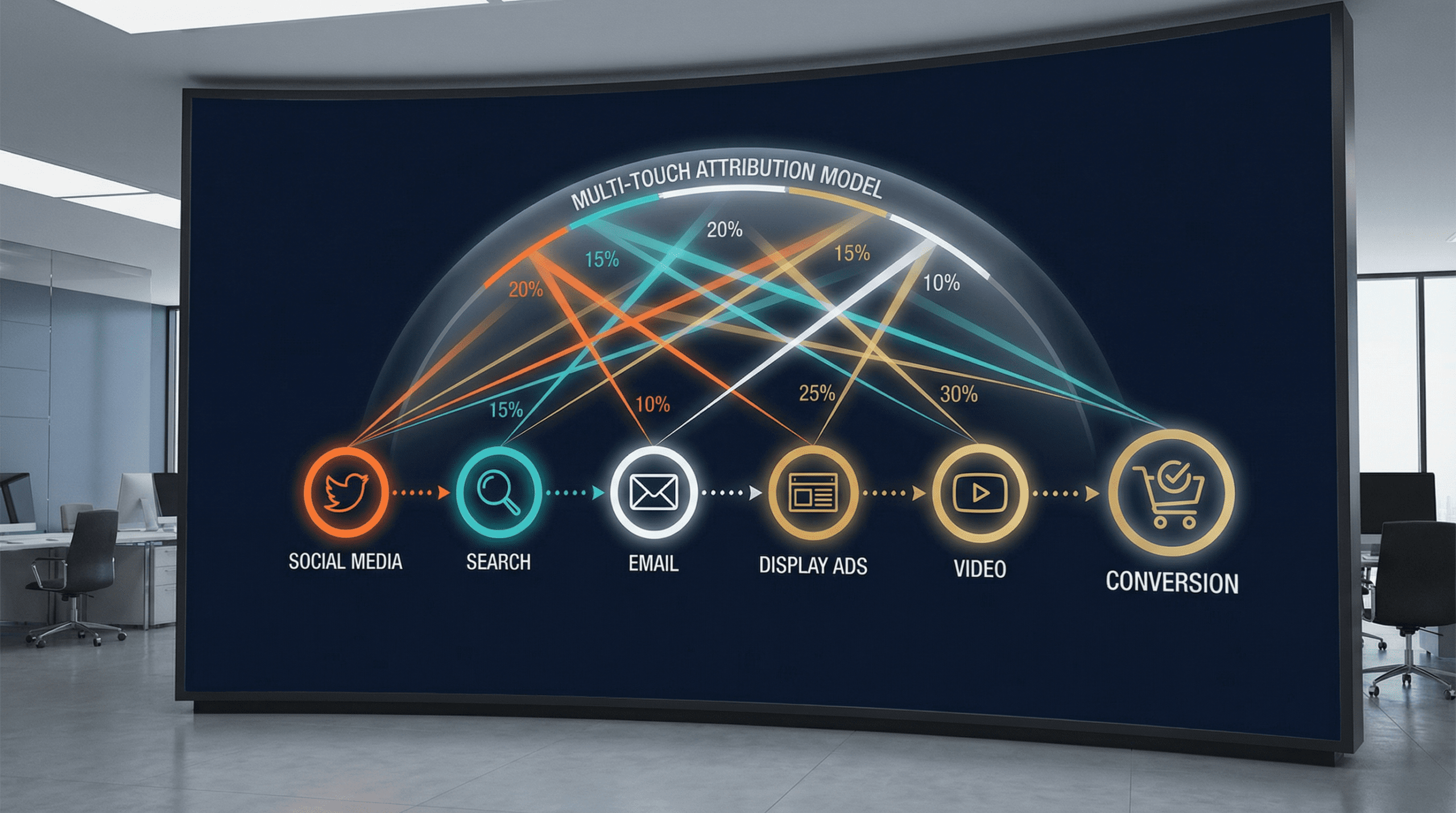
If last-click attribution is a solo performance, multi-touch attribution is a symphony. Instead of giving all the credit to a single touchpoint, multi-touch attribution models distribute credit across multiple touchpoints in the customer journey. This provides a more holistic and accurate view of marketing performance, allowing you to understand how different channels and campaigns work together to drive conversions.
There are several different multi-touch attribution models, each with its own unique way of assigning credit. Here are some of the most common models:
| Model | Description | Pros | Cons |
|---|---|---|---|
| Linear | Assigns equal credit to every touchpoint in the customer journey. | Simple to implement and understand. | Doesn’t differentiate between the impact of different touchpoints. |
| Time-Decay | Gives more credit to touchpoints that occur closer in time to the conversion. | Reflects the fact that touchpoints closer to the conversion are often more influential. | Can undervalue early touchpoints that play a crucial role in building awareness. |
| U-Shaped | Assigns 40% of the credit to the first touchpoint, 40% to the last touchpoint, and distributes the remaining 20% evenly across the touchpoints in between. | Gives more weight to the two most important touchpoints in the customer journey: the first touch and the last touch. | Can undervalue the touchpoints in the middle of the journey. |
| W-Shaped | Similar to the U-shaped model, but it also gives credit to the touchpoint where the customer became a lead. It assigns 30% of the credit to the first touch, 30% to the lead creation touch, and 30% to the last touch, distributing the remaining 10% across the other touchpoints. | Provides a more nuanced view of the customer journey by giving credit to three key milestones. | Can be more complex to implement than other models. |
| Custom | Allows you to create your own rules for assigning credit based on your specific business goals and customer journey. | Provides the most accurate and customized view of marketing performance. | Requires a deep understanding of your data and the ability to build a custom model. |
Choosing the right multi-touch attribution model depends on a variety of factors, including your business goals, sales cycle, and the complexity of your customer journey. There is no one-size-fits-all solution, so it’s important to carefully consider the pros and cons of each model before making a decision.
The Holy Grail of Attribution: Data-Driven Models
While the multi-touch models we’ve discussed offer a significant improvement over last-click attribution, they still rely on predetermined rules for assigning credit. Data-driven attribution takes a more sophisticated approach. Instead of using a one-size-fits-all model, data-driven attribution uses machine learning to analyze your unique conversion data and create a custom model that reflects how your customers actually interact with your marketing.
Data-driven attribution models analyze all of the different paths that your customers take to conversion, as well as the paths of customers who don’t convert. By comparing these two groups, the model can identify the touchpoints that have the greatest impact on the likelihood of conversion. This allows the model to assign credit to each touchpoint based on its actual contribution to the conversion, rather than on a set of predefined rules.
The benefits of data-driven attribution are significant:
The benefits of data-driven attribution are significant. Because these models are based on your specific data, they provide a much more accurate view of marketing performance than any other model, offering unparalleled accuracy. They can also uncover hidden patterns and insights that you would never be able to see with other models, providing actionable insights that can help you make smarter decisions about budget allocation, campaign optimization, and more. Finally, data-driven attribution models are not static; they continuously learn and adapt as your business and your customers change, ensuring that your attribution model always reflects the current state of your marketing.
Of course, data-driven attribution is not without its challenges. It requires a large amount of data to be effective, and it can be more complex to implement than other models. However, for businesses that are serious about optimizing their marketing and maximizing their ROI, data-driven attribution is the future of marketing measurement.
Choosing Your North Star: How to Select the Right Attribution Model
With so many different attribution models to choose from, it can be difficult to know which one is right for your business. The truth is, there is no single “best” attribution model. The right model for you will depend on a variety of factors, including your business goals, your sales cycle, and the marketing channels you use. Here’s a framework to help you make the right choice:
1. Define Your Business Goals: What are you trying to achieve with your marketing? Are you focused on generating new leads, driving sales, or building brand awareness? Your attribution model should align with your primary business objectives. For example, if your main goal is to generate new leads, a first-touch attribution model might be a good choice. If you’re focused on driving sales, a last-touch or data-driven model might be more appropriate.
2. Understand Your Sales Cycle: How long does it typically take for a customer to make a purchase after their first interaction with your brand? If you have a short sales cycle, a simple model like last-touch or first-touch might be sufficient. However, if you have a long and complex sales cycle with multiple touchpoints, a multi-touch or data-driven model will provide a more accurate view of your marketing performance.
3. Analyze Your Marketing Channels: Which marketing channels do you use to reach your customers? Do you rely heavily on a single channel, or do you use a mix of different channels? If you use a variety of channels, a multi-touch model will help you understand how they work together to drive conversions. If you’re just starting out and only using one or two channels, a simpler model might be a better place to start.
4. Consider Your Resources: Do you have the data, tools, and expertise to implement a complex attribution model? Data-driven attribution, for example, requires a significant amount of data and technical expertise. If you’re a small business with limited resources, it might be more practical to start with a simpler model and then gradually move to a more sophisticated model as your business grows.
By carefully considering these factors, you can choose an attribution model that will provide you with the insights you need to make smarter marketing decisions and achieve your business goals.
From Theory to Practice: Implementing Modern Marketing Attribution
Implementing a modern attribution model is not a simple flip of a switch. It requires careful planning, clean data, and the right tools. Here are the key steps involved in making the transition from last-click to a more sophisticated attribution model:
1. Establish Clear Objectives: Before you do anything else, you need to define what you want to achieve with your new attribution model. Are you looking to improve budget allocation, optimize your marketing mix, or gain a deeper understanding of your customer journey? Your objectives will guide your implementation process and help you measure success.
2. Ensure Data Quality and Integrity: A successful attribution model is built on a foundation of clean, accurate data. This means you need to have proper tracking in place across all of your marketing channels. This includes using UTM parameters on your URLs, implementing tracking pixels on your website, and integrating your various marketing platforms. It’s also important to have a process for cleaning and validating your data to ensure its accuracy.
3. Choose the Right Tools: There are a variety of tools available to help you implement and manage your attribution model, from free tools like Google Analytics to enterprise-level platforms. The right tool for you will depend on your budget, your technical resources, and the complexity of your attribution model. Do your research and choose a tool that meets your specific needs.
4. Start Small and Iterate: Don’t try to boil the ocean. If you’re new to attribution, start with a simple model like linear or time-decay. Once you’re comfortable with the basics, you can gradually move to a more sophisticated model. The key is to start small, learn from your data, and iterate over time.
5. Socialize the Change: Implementing a new attribution model is not just a marketing initiative; it’s a business-wide change. It’s important to get buy-in from all stakeholders, including sales, finance, and the executive team. Educate them on the benefits of the new model and how it will help the business make smarter decisions.
By following these steps, you can successfully implement a modern attribution model that will provide you with the insights you need to drive growth and maximize your marketing ROI.
Your Partner in the Attribution Revolution
By moving beyond last-click and embracing a more sophisticated approach to attribution, you can gain a deeper understanding of your customers, make smarter investment decisions, and ultimately, drive better results. The journey to attribution maturity is not always easy, but the rewards are well worth the effort. The future of marketing is attributed, and the time to embrace it is now.
References
[1] Marketing Attribution Models | How to Сhoose for 2026
[2] Marketing Attribution Models: Pros and Cons of Each Type
[3] Marketing attribution — models and best practices
Frequently Asked Questions About Marketing Attribution
What is last-click attribution and why is it a problem?
Last-click attribution is a measurement model that gives 100% of the credit for a conversion to the final marketing touchpoint before a purchase. It is problematic because it ignores all the earlier interactions that influenced the customer\’s decision, leading to underinvestment in awareness and consideration channels.
What is multi-touch attribution?
Multi-touch attribution is a measurement approach that distributes credit for a conversion across multiple marketing touchpoints in the customer journey. Common models include linear, time-decay, U-shaped, and W-shaped attribution, each offering a different perspective on how channels contribute to conversions.
What is data-driven attribution?
Data-driven attribution uses machine learning to analyze your specific conversion data and create a custom model that reflects how your customers actually interact with your marketing. It identifies which touchpoints have the greatest impact on conversion likelihood, providing the most accurate view of marketing performance.
How do I choose the right attribution model for my business?
The right model depends on your business goals, sales cycle length, and the complexity of your customer journey. Businesses with longer sales cycles and multiple channels benefit most from data-driven models. The key is to move beyond last-click and start capturing the full picture of your marketing effectiveness.
How does attribution affect budget allocation?
Attribution directly impacts how you allocate your marketing budget. With last-click attribution, you tend to over-invest in bottom-of-funnel channels and under-invest in awareness. Modern attribution models reveal the true contribution of each channel, allowing you to optimize your marketing mix for maximum ROI across the entire funnel.
Related Reading
About Colling Media
Colling Media is a full-service advertising agency headquartered in Phoenix, Arizona, specializing in Brand, Demand, Performance, and Nurturing (BDPN) strategies. With deep expertise in attribution, media buying, and data-driven marketing, Colling Media helps brands across industries including education, home services, transportation, and technology achieve measurable growth. Learn more at collingmedia.com.