

Why Your Brand Isn’t Appearing in ChatGPT and Google AI Answers (And How to Fix It)
Imagine a potential customer asking ChatGPT to recommend a company that provides exactly what your business offers.
Three competitors appear in the answer. Your brand doesn’t.
You check Google and discover that your website ranks well for relevant keywords. Your SEO reports show consistent traffic. Your company has years of experience, positive customer reviews, and an established reputation.
So why isn’t your business showing up in ChatGPT or Google AI answers?
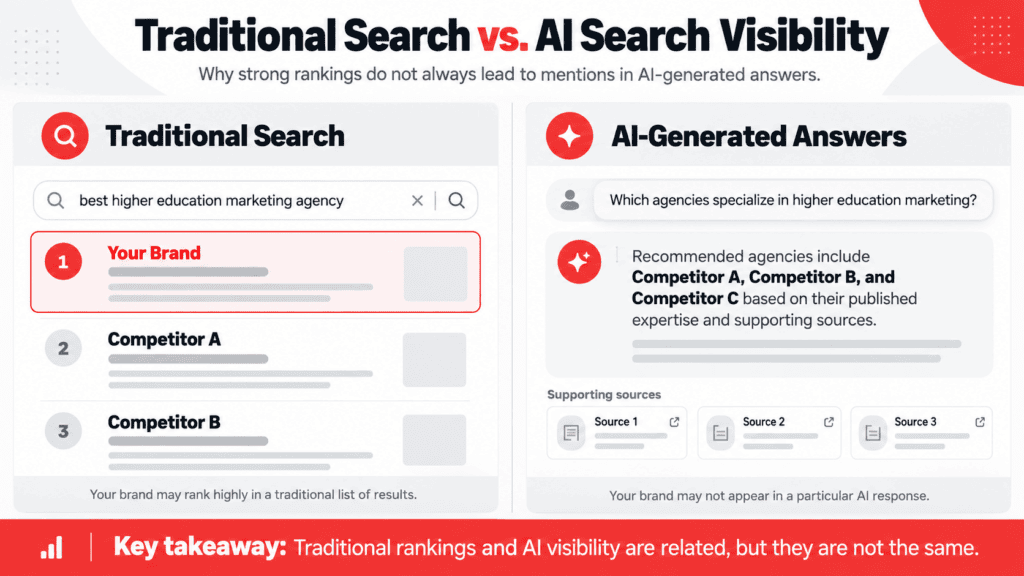
The problem may not be your traditional SEO performance. Ranking in search results and being mentioned or cited in an AI-generated answer are related, but they aren’t the same thing.
Your brand may be missing because AI search systems can’t access important content, your website doesn’t clearly communicate your expertise, or competing sources provide stronger information for the questions potential customers are asking.
The solution starts with diagnosing the problem, not chasing another optimization tactic.
This guide explains seven common reasons businesses are missing from AI-generated answers, how to identify the underlying issues, and what to fix first.
Why Doesn’t My Business Show Up in ChatGPT or Google AI?
ChatGPT and Google’s AI-powered search features can use information from websites and other sources to generate responses to user questions. However, they don’t necessarily select the same sources, produce the same recommendations, or follow the same discovery processes.
Google AI Overviews and AI Mode operate within Google’s search ecosystem. ChatGPT has its own search capabilities and may use retrieved information when answering questions.
That means a business can appear prominently in traditional Google results without being mentioned in a particular AI-generated answer.
The most common issues involve technical accessibility, unclear website content, unanswered buyer questions, limited supporting evidence, inconsistent business information, stronger competing sources, or inadequate visibility measurement.
Not every missing mention indicates a website problem. AI-generated answers can vary, and some questions simply don’t call for a company recommendation.
Understanding the difference is essential before deciding where to invest.
The 7 Reasons Your Brand Isn’t Appearing in AI Search
1. AI Search Crawlers Can’t Access Your Website
Before an AI-powered search experience can use information from your website, that information generally needs to be accessible through its discovery or retrieval systems.
Unfortunately, websites sometimes unintentionally restrict access.
A robots.txt configuration might block certain crawlers. Important pages may contain noindex directives. A security firewall could deny automated requests. Valuable content might be hidden behind authentication, inaccessible scripts, or technical errors.
There is also an important distinction between the systems used by ChatGPT and Google.
OpenAI uses OAI-SearchBot to discover content for ChatGPT search. Its separate GPTBot crawler is associated with potential model-training use. Website owners can allow OAI-SearchBot while restricting GPTBot.
Google says that pages considered for supporting links in AI Overviews and AI Mode must be indexed and eligible to appear in Google Search with a snippet. There are no additional technical requirements specifically for these AI search features.
For marketers, this means a website’s technical SEO foundation still matters.
How to identify the problem: Review Google Search Console for indexing issues. Check whether your most important service and industry pages are accessible. Have your technical team inspect robots.txt, noindex directives, server responses, and firewall rules affecting legitimate search crawlers.
What to fix: Remove unintended restrictions, repair broken pages, and ensure important content can be discovered and accessed.
For more detail, consult OpenAI’s crawler documentation and Google’s guidance on AI features and websites.
Resolving technical barriers makes relevant information accessible. It does not guarantee inclusion in AI-generated answers.
2. Your Website Doesn’t Clearly Explain What Your Business Does
Many business websites are designed to impress visitors rather than answer their questions.
Consider this common type of agency positioning:
“We deliver innovative marketing solutions that accelerate growth and maximize results.”
It sounds professional, but what does the company actually do? Which industries does it serve? What makes it different from hundreds of competitors?
Now consider a more specific description:
“We help higher education institutions increase qualified student inquiries through paid search, paid social, video advertising, and conversion tracking.”
The second version communicates the company’s services, audience, and business objective.
Those details matter when a prospective customer asks ChatGPT to recommend an agency with a specific capability.
A vague homepage can make it harder for customers to understand your business and may provide less useful information for systems assembling answers to specific questions.
The same problem often appears on service pages. A website might identify “Paid Media” as a service without explaining the channels involved, the problems it addresses, or the outcomes it helps businesses pursue.
How to identify the problem: Read your homepage and primary service pages as though you’ve never heard of the company. Can you determine what the business offers, whom it serves, which markets it operates in, and why someone would choose it?
What to fix: Replace generic descriptions with clear, specific explanations of services, industries, customer problems, and relevant capabilities.
Don’t abandon persuasive brand language. Support it with information that makes your expertise understandable.
3. Your Content Doesn’t Answer the Questions Buyers Actually Ask
Traditional keyword research often begins with short search phrases.
But potential customers increasingly use detailed, conversational questions when exploring business decisions.
A marketing director might ask:
“Which advertising agencies specialize in increasing enrollment for career and technical colleges?”
A retailer might ask:
“How can I tell whether my paid social campaigns are generating incremental sales instead of purchases that would have happened anyway?”
A home services company might ask:
“What should I look for in a marketing agency that understands seasonal demand and local service areas?”
These questions are more specific than a general keyword such as “digital marketing agency.”
They reveal the buyer’s industry, business problem, expectations, and decision criteria.
If your website only explains broad services, it may not provide enough relevant detail to support an answer to those questions.
How to identify the problem: Examine the questions prospects ask during sales calls, consultations, and customer interactions. Compare them with your website’s existing information.
If your prospects routinely ask about pricing models, reporting capabilities, industry experience, implementation timelines, or measurable results, those topics deserve clear answers.
What to fix: Strengthen existing pages and develop useful content addressing the questions that influence purchasing decisions.
The goal isn’t to create hundreds of thin articles targeting every possible variation of a question.
Google’s 2026 guide to optimizing for generative AI search emphasizes valuable, original content and cautions against mass-producing pages solely to manipulate AI search visibility.
One thorough, authoritative page can be more useful than dozens of repetitive articles.
4. Your Website Doesn’t Provide Enough Evidence of Your Expertise
Anyone can claim to deliver outstanding results.
A stronger website explains what those results mean, how they were achieved, and why the business is qualified to deliver them.
Consider two companies competing for the same customer.
The first says it specializes in performance marketing and uses data-driven strategies to improve ROI.
The second demonstrates how it identified a campaign measurement problem, improved conversion tracking, adjusted media investment, and evaluated the resulting business outcomes.
The second provides more substantial information for a buyer to evaluate.
That evidence may also make the company’s content more relevant when an AI-powered search experience looks for information about the topic.
Effective supporting evidence can include documented case studies, original research, technical expertise, credible third-party references, and detailed explanations of real business challenges.
For Colling Media, this is an important distinction between describing a capability and demonstrating expertise.
A service page stating that an agency provides conversion tracking is informative. A case study explaining how an agency connected advertising interactions with qualified leads or purchases is more substantial.
How to identify the problem: Review the most important claims on your website. Are they supported by meaningful examples and verifiable information?
What to fix: Add original insights, documented outcomes, relevant credentials, and firsthand examples wherever they genuinely improve the reader’s understanding.
Avoid publishing unsupported performance claims or presenting generic AI-generated advice as original expertise.
The objective isn’t to convince an AI system that you’re an authority. It’s to give customers and search systems useful evidence of what your organization knows and does.
5. Your Brand Information Is Inconsistent Across the Web
Your website isn’t the only place information about your business appears.
Potential customers may encounter your company through industry associations, business directories, review platforms, news coverage, professional profiles, and other independent sources.
Those sources can provide additional context about your organization.
But what happens when they disagree?
Your website identifies your business as a full-service advertising agency. An outdated directory classifies it as a social media agency. Another listing uses an old business name or describes services you no longer provide.
Those inconsistencies can confuse prospective customers and make your business harder to identify accurately.
This doesn’t mean every business needs mentions on hundreds of websites.
Accuracy and relevance matter more than volume.
How to identify the problem: Search for your company name, core services, primary locations, and important business identifiers. Compare how your organization is described across credible sources.
Pay particular attention to information that could cause customers to misunderstand your expertise or confuse your business with another company.
What to fix: Correct outdated listings, maintain accurate business information, and pursue legitimate industry coverage when your company has something meaningful to contribute.
Avoid artificial mentions, purchased endorsements, or low-quality directory submissions designed solely to influence search systems.
The objective is a consistent, accurate digital presence supported by credible information.
6. Your Competitors Provide Better Answers to the Same Questions
Sometimes the problem isn’t that your website lacks information.
It’s that your competitors have published more relevant information for a specific customer question.
Imagine someone asks ChatGPT:
“Which marketing agencies have experience generating qualified leads for higher education institutions?”
Several competitors appear, but your company doesn’t.
Rather than assuming the competitors have discovered a secret AI optimization technique, examine the available evidence.
Do they have detailed education marketing pages? Are their services clearly explained? Have they published enrollment-focused case studies? Are they referenced by relevant industry publications?
Now compare those findings with your own website.
The exercise may reveal that your organization has the necessary experience but hasn’t documented it clearly enough.
This is where competitive analysis becomes especially useful.
How to identify the problem: Test relevant purchasing questions, review the brands mentioned, examine supporting citations, and compare the information available about competing businesses.
Consider whether your content actually answers the question as thoroughly as the competing sources.
What to fix: Develop original information that addresses legitimate gaps. Expand relevant service descriptions, document industry experience, and explain approaches or results that distinguish your organization.
Don’t copy the pages receiving citations. Use them to understand what information buyers need and where your own expertise can add value.
It’s also important to recognize that AI responses aren’t fixed rankings. A competitor appearing in one response doesn’t establish permanent dominance.
7. You’re Measuring Google Rankings Instead of AI Search Visibility
Traditional SEO performance still matters.
But tracking keyword rankings and organic traffic alone doesn’t explain how your business appears across AI-powered search experiences.
A company could rank highly in conventional search results and receive few visible mentions across a sample of AI-generated answers.
Another company might receive frequent mentions but little referral traffic.
A third might generate fewer AI referrals, yet those visitors could become qualified leads.
Each situation requires a different interpretation.
For effective measurement, businesses need to distinguish among brand mentions, website citations, referral traffic, and actual business outcomes.
A brand mention occurs when an AI-generated answer identifies your company.
A citation occurs when the answer provides a supporting link or source reference. A citation to your website is different from a mention of your brand supported by another publisher.
Referral traffic occurs when someone follows a link from an AI experience to your website.
Business outcomes include meaningful actions such as qualified inquiries, appointments, purchases, or enrollment applications.
These outcomes aren’t interchangeable.
How to identify the problem: Review your current marketing reports. Determine whether they separately capture AI search visibility, AI referral traffic, and qualified conversions.
What to fix: Establish consistent measurement for the questions and platforms most relevant to your business.
Google’s Search Console introduced dedicated generative AI performance reporting in June 2026, with worldwide rollout completed August 31, 2026. The reports provide information about impressions, pages, countries, devices, and performance over time.
For ChatGPT, website owners can analyze identifiable referral traffic and use consistent prompt-based monitoring to observe mentions and citations.
No single metric provides a complete picture. The objective is to connect AI discoverability with meaningful marketing performance.
The 10-Minute AI Search Visibility Self-Audit
Before investing in a new GEO strategy, spend ten minutes checking whether your business has an identifiable visibility problem.
This is a preliminary diagnostic exercise, not a complete technical SEO audit.
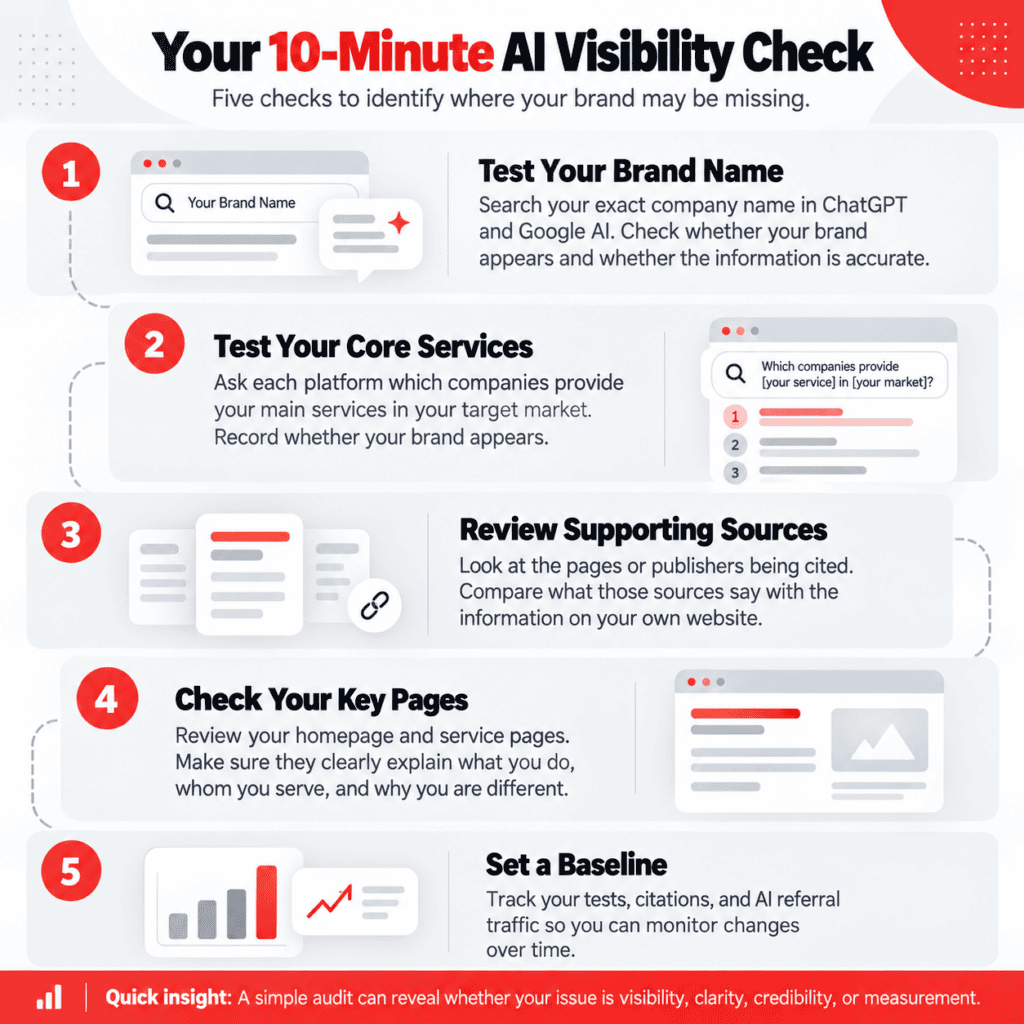
Open ChatGPT search and Google’s available AI search experience.
Search for your company using its exact business name. Then ask what the company does and which services it offers.
Check whether the information is accurate and whether the response references your website.
If your business is absent or inaccurately described, investigate whether the issue involves accessibility, limited publicly available information, or brand-name ambiguity.
Minutes 3–4: Test Your Core Services
Ask each platform to recommend providers offering your main services in your target market.
For example, an agency might test:
“Which advertising agencies specialize in higher education marketing in the United States?”
Record whether your brand appears and which competitors are mentioned.
Repeat the exercise with a question focused on a specific industry or capability.
This helps distinguish branded discoverability from visibility during an actual provider-selection process.
Minutes 5–6: Examine the Supporting Sources
Look at the websites linked or cited in the responses.
Determine whether they are company service pages, independent publications, case studies, directories, or other resources.
Ask what makes those sources relevant to the question.
Are they more specific about the industry? Do they provide original information? Are they easier to understand?
This comparison can reveal where your own content may be incomplete.
Minutes 7–8: Review Your Website’s Most Important Pages
Open your homepage and a primary service page.
Confirm that they clearly explain the services you provide, your target audiences, the problems you address, and relevant evidence of your expertise.
If you’re struggling to identify that information quickly, prospective customers may be struggling too.
Minutes 9–10: Establish Your Measurement Baseline
Review Google Search Console’s generative AI reporting and check your analytics for identifiable AI referral traffic.
Record the questions tested, date, platform, brands mentioned, and sources cited.
Repeat the same tests periodically.
Because AI answers can vary, ten minutes won’t establish a statistically reliable share-of-voice measurement. It will, however, help identify where a more comprehensive investigation should begin.
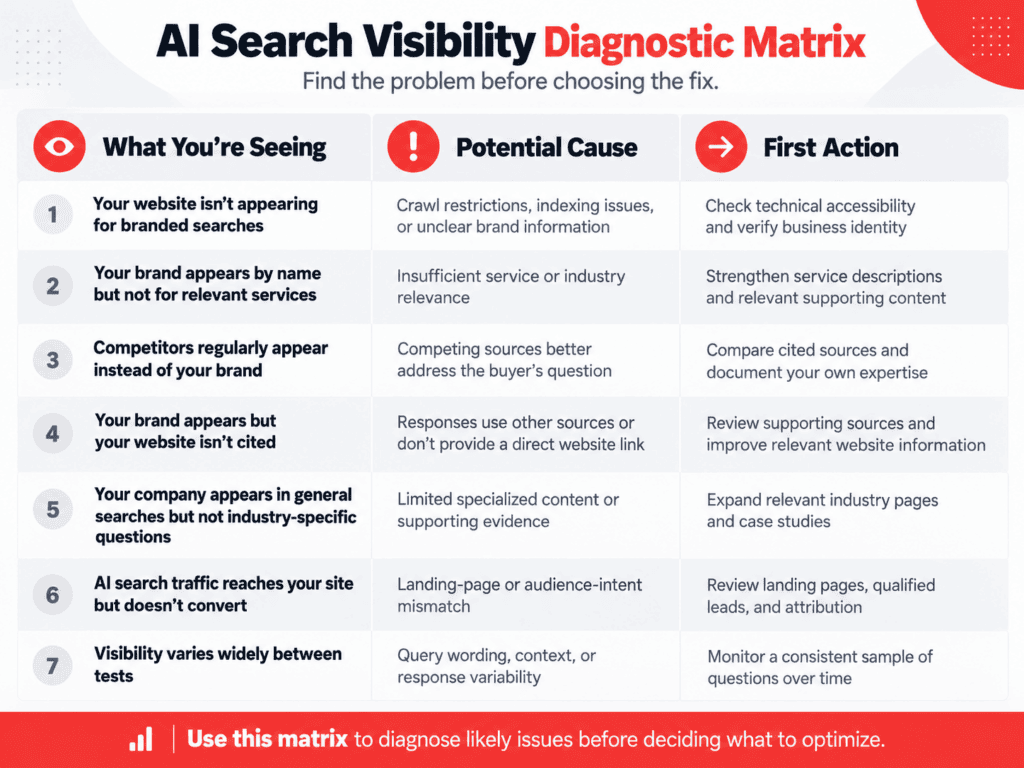
AI Search Visibility Diagnostic Matrix: Find the Problem Before Choosing the Fix
Use the following matrix to connect common AI search visibility problems with potential causes and the appropriate first steps.
| What You’re Seeing | Potential Cause | First Action |
|---|---|---|
| Your website isn’t appearing for branded searches | Crawl restrictions, indexing issues, or unclear brand information | Check technical accessibility and verify business identity |
| Your brand appears by name but not for relevant services | Insufficient service or industry relevance | Strengthen service descriptions and relevant supporting content |
| Competitors regularly appear instead of your brand | Competing sources better address the buyer’s question | Compare cited sources and document your own expertise |
| Your brand appears but your website isn’t cited | Responses use other sources or don’t provide a direct website link | Review supporting sources and improve relevant website information |
| Your company appears in general searches but not industry-specific questions | Limited specialized content or supporting evidence | Expand relevant industry pages and case studies |
| AI search traffic reaches your site but doesn’t convert | Landing-page or audience-intent mismatch | Review landing pages, qualified leads, and attribution |
| Visibility varies widely between tests | Query wording, context, or response variability | Monitor a consistent sample of questions over time |
These are possible explanations, not verified diagnoses. A missing mention can occur even when a website is technically sound and its content is useful.
The matrix is intended to prioritize investigation rather than prescribe the same solution to every business.
How to Improve Your Brand’s Visibility in ChatGPT and Google AI
Once you’ve identified the likely issues, prioritize improvements based on their potential impact.
If your website has crawl or indexing restrictions, start with technical accessibility. Creating more content won’t solve a problem that prevents relevant pages from being discovered.
If your website is accessible but lacks clear service information, strengthen the pages closest to the purchase decision.
If competitors provide stronger answers, invest in original expertise, useful comparisons, and documented business examples.
If your brand appears in AI answers but generates little business value, examine the relationship between visibility, referral traffic, landing pages, and conversions.
Avoid treating generative engine optimization as a collection of shortcuts.
Google’s published guidance specifically advises website owners to prioritize unique, valuable content and foundational SEO rather than tactics such as unnecessary AI-specific files, artificial mentions, or content created solely to manipulate generative search results.
For most established businesses, the most effective strategy is to make useful information about their services and expertise easier to discover, understand, and verify.
That requires coordination between SEO, website development, content strategy, and measurement.
It’s a business-wide discoverability challenge, not simply a new responsibility for the person managing keywords.
How Do You Measure Whether AI Search Optimization Is Working?
Improved visibility only matters when it supports your broader marketing objectives.
Start by monitoring your presence across a consistent set of commercially relevant questions.
Track which questions produce brand mentions, when your website receives citations, and which competitors appear.
Next, measure identifiable AI referral traffic and the landing pages those visitors enter.
Finally, evaluate what happens after the visit.
Do AI-referred visitors engage with service content? Are they completing inquiry forms? Are those inquiries qualified? Can your reporting connect them to downstream outcomes?
Google’s generative AI performance reporting can help identify which website pages receive exposure through Google’s AI features.
ChatGPT referrals can be analyzed through web analytics when referral information or tracking parameters are available. OpenAI’s publisher guidance explains how publishers can identify ChatGPT referral activity.
However, remember that AI-generated answers don’t always produce clicks. Some consumers may learn about your brand within an answer and visit your website later through another channel.
For this reason, AI visibility reporting should complement established SEO, attribution, and lead-quality measurement rather than replace them.
An increase in brand mentions may indicate improved discoverability. An increase in qualified conversions provides stronger evidence of business value.
When Should Your Business Conduct an AI Search Visibility Audit?
An AI visibility audit is particularly valuable when a business ranks well in traditional search but rarely appears in relevant AI-generated answers.
It can also be useful when launching new services, entering new markets, redesigning a website, or comparing your company’s digital presence against competing providers.
Marketing leaders should also consider an audit when they lack confidence in how AI-originated traffic is being measured or whether existing content supports important customer questions.
A meaningful audit examines technical access, service-page relevance, content completeness, supporting evidence, competitor visibility, and measurement quality.
The result should be a prioritized understanding of what needs attention.
Not every business requires more blog content. Some need stronger service pages. Others need technical fixes, clearer positioning, or more accurate attribution.
The first step is determining which of those issues actually applies.
Frequently Asked Questions About AI Search Visibility
Why does ChatGPT recommend my competitors but not my business?
Competitors may provide more relevant information for the question, have stronger supporting evidence, or be better represented in accessible sources. However, ChatGPT responses vary, and one recommendation isn’t proof of a permanent ranking advantage. Compare results across multiple relevant questions and investigate the cited information before identifying a cause.
How do I get my business to show up in ChatGPT search results?
Make sure your public website is accessible to OAI-SearchBot, clearly explains your products or services, and provides useful information about your expertise. Improve the quality and completeness of relevant pages and maintain accurate external business information. These steps support discoverability but do not guarantee that ChatGPT will mention or recommend your company.
Can my business appear in ChatGPT without ranking first on Google?
Yes. A first-place Google ranking isn’t a universal requirement for appearing in ChatGPT. The platforms use different systems to retrieve and present information. Strong traditional SEO can support online discoverability, but it doesn’t guarantee visibility in every AI-generated response.
Why isn’t my website appearing in Google AI Overviews?
Your website may not be indexed, may be ineligible for a Google Search snippet, or may not be selected as a useful supporting source for a particular query. Google also doesn’t display AI Overviews for every search. Its guidance recommends focusing on technical SEO, reliable content, and useful information rather than special AI-specific optimization tactics.
How long does it take to improve AI search visibility?
There is no guaranteed timeframe. Technical changes may be processed faster than broader improvements to content, reputation, or relevance. Monitor results across multiple reporting periods and distinguish between completed optimization work and observable changes in AI search appearances.
Do I need special schema markup or an llms.txt file to rank in AI answers?
Google says there are no special schema requirements for inclusion in AI Overviews or AI Mode. Its guidance also cautions against unnecessary AI-specific files or content restructuring pursued as ranking shortcuts. Valid structured data can still help search systems understand relevant page information, but it doesn’t guarantee an AI citation.
What’s the difference between appearing in an AI answer and receiving a citation?
A brand mention occurs when an answer names your business. A citation provides a link to a supporting source, which may or may not be your website. These should be measured separately because a business can be mentioned without a direct website citation, and its content can sometimes be cited without a prominent brand recommendation.
Can businesses pay to appear in ChatGPT recommendations?
Advertising and organic recommendations are separate. Purchasing advertising does not guarantee that your business will be recommended organically or that your website will be cited as a source. Be skeptical of services promising guaranteed organic placement in AI-generated answers.
You may also fine this article informative: GEO vs. SEO: Why Your Brand Needs Generative Engine Optimization in 2026