

Why Paid Media Strategy Fragments Even When Your Campaigns Look Healthy
A paid media strategy becomes fragmented when channels are planned separately, reports use different definitions, and no one owns the decisions that connect them. Each campaign may hit its own target while the business still cannot answer a basic question: What should we change across the entire advertising investment to improve results?
Adding another dashboard will not answer it. The practical work is to connect three things: what each channel is supposed to accomplish, which data the team trusts, and who can act when that data points to a change.
What does a fragmented paid media strategy look like?
Fragmentation does not always show up as a failing campaign. Paid search may generate leads at an acceptable cost. Paid social may deliver strong engagement. A connected TV campaign may reach the intended market. Yet those reports can all look healthy while lead quality declines, audiences receive the wrong message, or the team cannot explain whether shifting budget would help.
The warning sign is local success without a clear business decision. A channel report says what happened inside a platform. An aligned media strategy explains what that result means for the customer journey and what the team will do next.
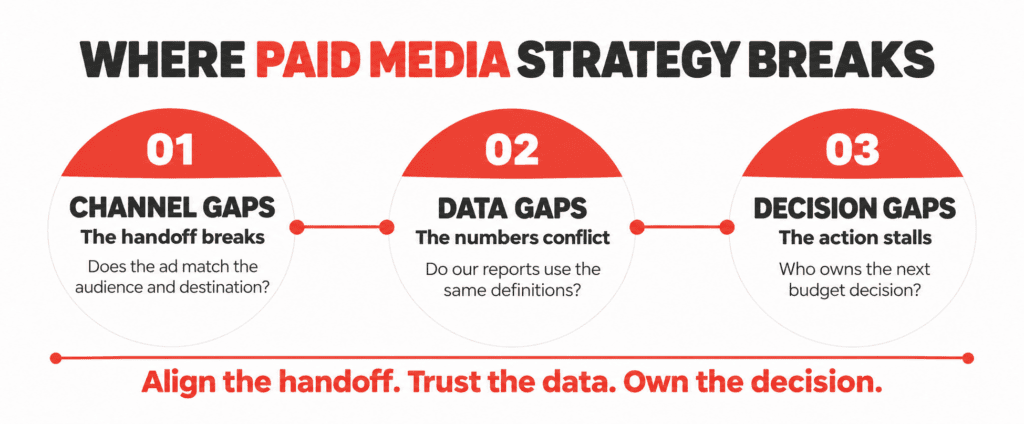
In our work at Colling Media, we find it useful to examine three operating gaps: the handoffs between channels, the definitions behind the data, and the decisions made from that data.
Where do channel gaps break the customer journey?
A channel gap appears when targeting, creative, search intent, landing pages, or timing are managed as separate assignments without checking how they work together.
In one campaign review, search queries for one product category were sending people to landing pages for another. The campaigns could still produce clicks, but the destination did not match what people had asked for. The issue was flagged for a query and URL audit. That is a useful reminder that traffic quality depends on the handoff after the click, as well as the targeting before it.
In another case, creative intended for existing audiences was being routed into prospecting, while lead-generation creative was being placed in retargeting. Required intake labels were added to make the intended audience clear when assets moved from creative planning to media execution. The process change addressed the routing problem; it would take separate performance evidence to establish its effect on results.
These issues are easy to miss when each team reviews only its own output. The question for a marketing leader is: Can we trace an ad from its intended audience and message through its placement, destination, and next customer action?
That question applies beyond digital campaigns. A radio or out-of-home message may prompt someone to search days later. Search copy and landing pages should reflect the offer or idea the person encountered earlier. The channels have different jobs, but the customer should experience a coherent path.
Why do reporting gaps lead to poor optimization decisions?
A reporting gap exists when teams use the same metric name for different calculations, combine sources without explaining their differences, or present numbers that have not been reconciled.
We have encountered dashboard views of the same campaign that did not tie out because their underlying sources and categories differed. In a separate review, a click-through rate appeared incorrectly in presentation materials because of a reporting or decimal issue. Neither situation can be solved by choosing whichever number looks more favorable.
Before interpreting performance, a team should know which source supplies each metric, what it includes, how it is calculated, and when it updates. If a platform reports leads, an analytics tool reports conversions, and a CRM reports qualified opportunities, those figures describe different events. They may all be useful. They should not be treated as interchangeable.
The question to ask is: Could someone outside the channel team reproduce the reported number and explain why it differs from another report? If the answer is no, reconcile the definitions before using the report to move budget.
Does attribution solve the reporting problem?
Attribution helps, but it cannot replace sound definitions or a decision process. Last-click reporting identifies the final recorded interaction before a conversion. It may miss earlier advertising that helped create interest. Other attribution approaches can add perspective, but no single model observes every influence on a customer or proves that every recorded touchpoint caused the result.
For businesses using digital and traditional media, it is often more useful to compare several kinds of evidence: channel delivery, website behavior, lead quality, sales outcomes, market-level changes, and well-designed tests where feasible. The goal is a better-informed decision, with the remaining uncertainty made clear.
Colling Media explains these measurement approaches in more detail in its guide to connecting advertising spend to business results.
When does a decision gap become a budget problem?
A decision gap appears when performance is reviewed regularly, but the team has no agreed rule for acting on it. Reports circulate, each specialist recommends improvements to their channel, and the broader budget remains on its original path.
For example, better-than-benchmark cost per lead led to an incremental allocation in one campaign. That was a reasonable signal for a measured change. It was not, by itself, proof that the additional leads would be qualified or become customers. In a separate planning discussion, channel-level conversion and acquisition-cost data was requested to assess lead quality before future budget allocations were set. The request identified the information needed; it did not establish what the eventual budget decision would be.
An effective review therefore goes beyond “Which CPL is lowest?” It asks: Which channel is producing the outcome we need, at what cost, with what confidence, and what should happen to the next available dollar?
Someone must own that answer. Channel specialists should bring evidence and recommendations. A designated strategy owner should weigh those recommendations against the shared business goal, authorize changes, and make the reasoning visible to the people executing them.
How can you align channels, data, and decisions?
Start with a business outcome precise enough to guide a tradeoff. “More leads” may reward inexpensive form fills. “More qualified opportunities at an acceptable acquisition cost” gives the team a stronger basis for comparing options. Define what qualifies, where that status is recorded, and how often it becomes available.
Then assign each channel a role in the journey. Colling Media’s BDPN framework describes those roles as Brand, Demand, Performance, and Nurture. Brand builds awareness. Demand creates interest. Performance captures intent. Nurture helps turn leads into customers and customers into advocates. A channel may support more than one stage, but its primary job and measures of success should be explicit.
Next, document the handoffs. Identify who approves the audience and message, who checks that creative is routed to the intended campaign, who verifies the landing page, and who monitors what happens after a lead arrives. This is where an integrated plan becomes an executable one.
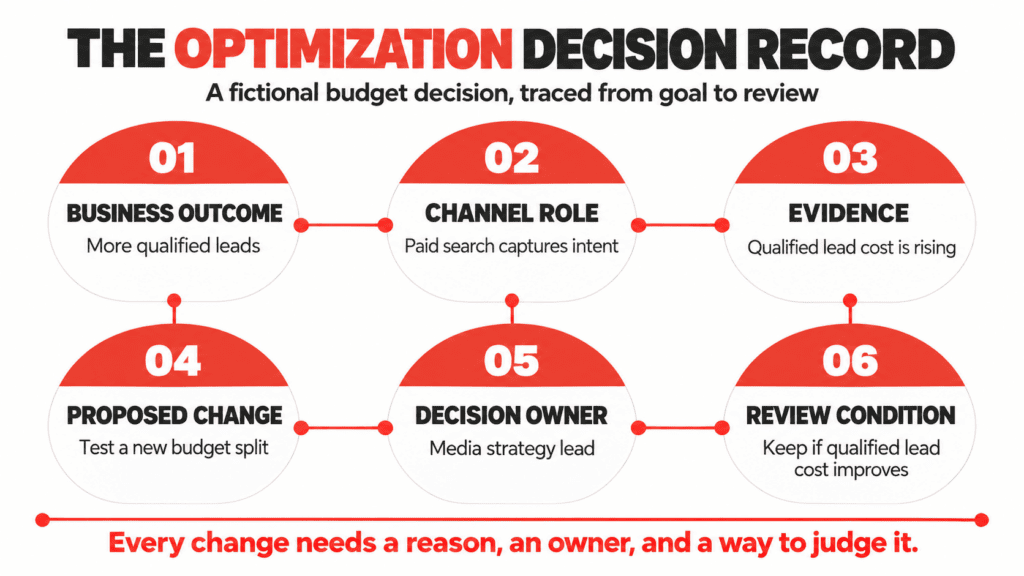
Finally, make every meaningful optimization recommendation traceable. A useful decision record states the business outcome at issue, the channel’s intended role, the evidence and its source, the proposed change, the person authorized to make it, and the result that would cause the team to keep or reverse it. This can be a short entry in an existing review document. Its value is that another person can understand the decision weeks later without reconstructing a meeting.
A working cadence gives that record a purpose. Frequent campaign checks can catch routing errors, broken destinations, and unusual reporting changes. Broader reviews can examine qualified outcomes, audience progression, and budget allocation after enough evidence has accumulated. The exact timing depends on spend, conversion volume, and sales cycle; the distinction is between correcting execution and changing strategy.
What should a CMO ask at the next media review?
Ask the team to walk through one recent optimization decision from beginning to end. What business result was it intended to improve? What job was the channel assigned? Did the reported numbers reconcile? What did the team learn about lead or customer quality? Who approved the change, and what evidence will determine whether it worked?
If those answers require several separate meetings, the opportunity is clear. The issue may not be a lack of campaigns or effort. It may be the operating connections between them.
At Colling Media, we help brands examine those connections across planning, execution, measurement, and optimization. If your channel reports look healthy but the next decision is still hard to make, let’s look at how your media works together.