

When media performance weakens, marketing teams often respond by changing channels, adjusting bids, refreshing creative, or moving budget.
Those actions can improve execution. They do not necessarily fix the strategy.
A campaign can produce efficient CPMs, healthy click-through rates, and acceptable cost per lead while still missing the business outcome leadership cares about. The reason is often not one bad platform. It is a disconnect between three decisions.
The first is what business problem the media investment is supposed to solve.
The second is which audiences are capable of changing that outcome.
The third is what those audiences need to hear before they act.
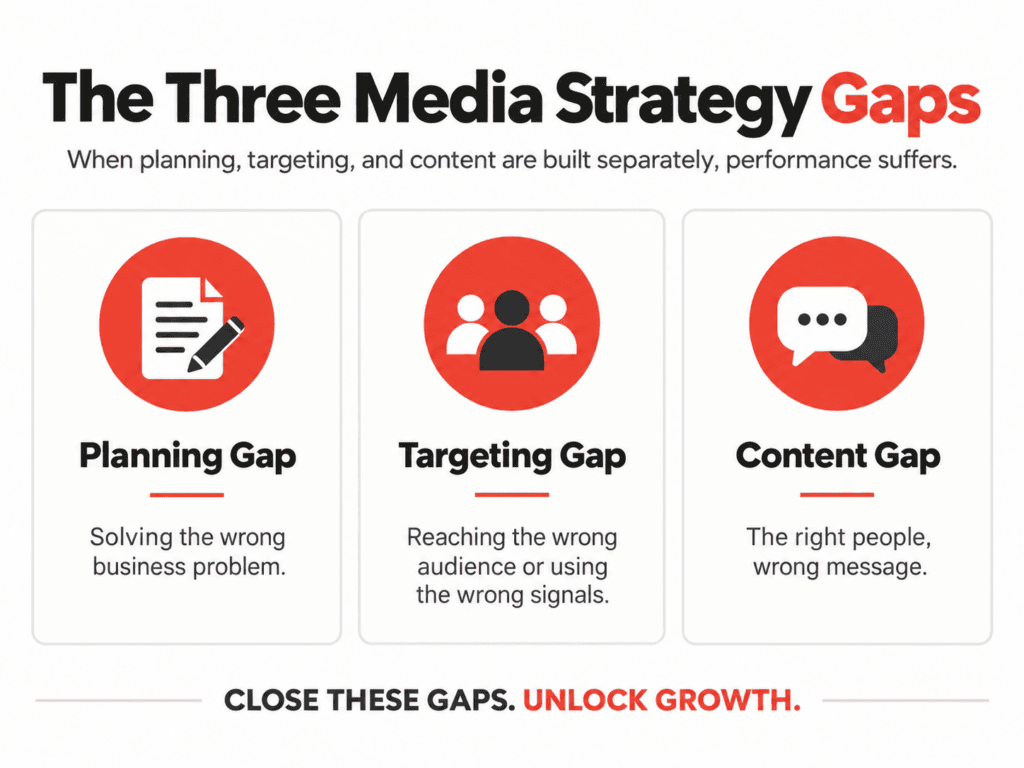
When planning, targeting, and content are built separately, each part of the campaign can look reasonable while the total system underperforms.
That is the media strategy gap.
For CMOs and marketing leaders, the implication is important. Before adding budget or replacing a channel, determine whether the strategy is aligned from business objective through audience, content, measurement, and optimization.
This article provides a practical way to make that diagnosis.
What Is a Media Strategy?
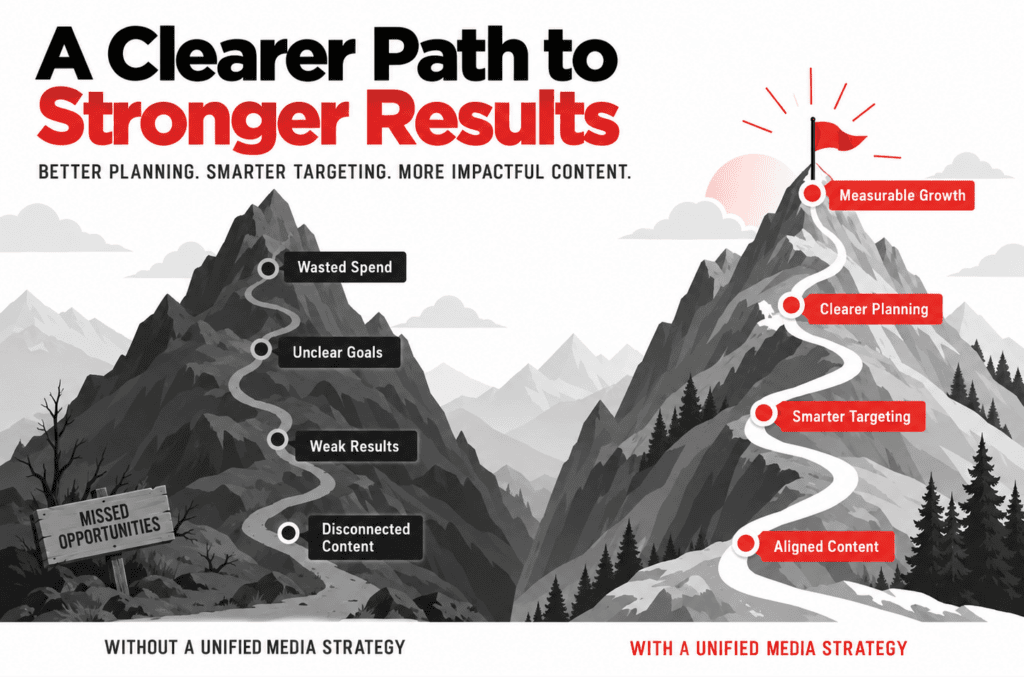
A media strategy is the decision system that determines who a company needs to reach, why those audiences matter, where and when to reach them, what message they should receive, and how the investment will be measured against business outcomes.
A media strategy is not the same as a media plan or media buying.
Media strategy answers the question: What business outcome are we trying to influence, with whom, and why?
Media planning answers: Which channels, markets, timing, and budget allocations support that strategy?
Media buying answers: How should inventory, bids, placements, and budgets be executed?
Media optimization answers: What should change as performance data accumulates?
The distinction matters because better execution cannot always compensate for poor strategic assumptions.
A paid social team can reduce cost per lead while sales quality declines.
A search campaign can generate strong return while reaching mostly people who were already close to purchasing.
An upper-funnel campaign can create meaningful reach while looking weak in a last-click report.
In each case, the channel may be doing what it was designed to do. The problem is that the campaign is being judged, targeted, or messaged against the wrong objective.
Why Do Media Strategies Underperform?
Media strategies most often underperform when business objectives, audience definitions, content strategy, channel roles, and measurement do not reflect the same assumptions.
A useful way to diagnose the problem is to examine three areas.
Planning asks whether you are solving the right business problem.
Targeting asks whether you are reaching people who can actually change the outcome.
Content asks whether you are giving those people a reason to act based on their needs, intent, and stage of consideration.
Together, these form a simple Planning-Targeting-Content Alignment Framework.
At Colling Media, one pattern we repeatedly see is that companies label a performance problem as a channel problem too early.
The campaign may be blamed on paid social, search, programmatic, or video when the real issue sits upstream in the objective, audience definition, conversion signal, or message strategy.
The most expensive media problems we see are often not caused by media cost. They are caused by optimizing toward the wrong business signal.
Before changing media, diagnose the system.
Gap 1: The Media Plan Is Solving the Wrong Business Problem
“We need more leads” is rarely specific enough to guide media strategy.
The business may actually need more qualified leads.
It may need a higher lead-to-sale conversion rate.
It may need a lower CAC, more pipeline from a specific segment, greater awareness in a new market, stronger demand for an underpenetrated product, or more revenue from existing customers.
Those are different problems.
They require different audiences, messages, media roles, budgets, and measurements.
Start With the Growth Constraint, Not the Channel
Media planning frequently begins with channel questions.
Should we spend more on paid search?
Should we add connected TV?
Should Meta receive more budget?
Should we test programmatic?
Those questions should come later.
The first question should be:
What is preventing the business from reaching the desired outcome?
Most media challenges can initially be organized into four broad categories.
Awareness Constraint
An awareness constraint exists when enough potential customers do not know the company, product, or category exists.
The role of media is to build qualified reach and memory.
Useful measurements may include reach, frequency, brand lift, branded search behavior, or changes in direct traffic.
Demand Constraint
A demand constraint exists when the market knows the category exists, but not enough people are actively considering the company or solution.
Media must increase relevance, educate buyers, create interest, or make a problem more salient.
Conversion Constraint
A conversion constraint exists when demand is present, but too few people take the required action.
The issue may involve high-intent media, offer strength, landing-page experience, pricing, lead handling, or sales follow-up.
Nurturing Constraint
A nurturing constraint exists when the company generates interest but loses prospects before purchase.
Media and content must sustain consideration instead of repeatedly paying to reacquire attention.
Colling Media uses a related Brand, Demand, Performance, and Nurturing framework to clarify the role different advertising activities play across the customer journey.
The principle is simple: different stages of growth require different media jobs and different definitions of success.
For low awareness, the media job is to build qualified reach.
For weak consideration, the job is to develop demand.
For insufficient leads or sales, the job is to capture intent.
For poor lead quality, the job is to improve targeting and signal quality.
For weak post-lead conversion, the job is to support progression.
For limited growth from existing channels, the job is to find incremental demand.
The important distinction is between activity metrics and business economics.
A campaign can reduce cost per lead while increasing customer acquisition cost.
It can generate more conversions while lowering average customer value.
It can improve ROAS in a platform while contributing little incremental revenue.
The more useful question is:
Did the media investment improve the business outcome at an acceptable marginal cost?
What We Commonly See: The KPI Is Technically Correct but Strategically Incomplete
One recurring issue is that a campaign is optimized against a metric that makes sense inside the platform but does not tell leadership whether growth quality improved.
A campaign may optimize to lead volume even though lead quality varies significantly.
It may report ROAS without separating existing demand from incremental demand.
It may judge upper-funnel media by direct conversions.
It may compare channels that perform different jobs using the same CPA target.
The fix is not more reporting.
It is a tighter connection between the KPI and the business decision the KPI is supposed to support.
Gap 2: The Audience Is Too Broad, Too Narrow, or Defined the Wrong Way
Audience strategy often gets reduced to targeting settings.
That is too narrow.
A useful audience definition should help distinguish between people who are easy to reach and people who are economically valuable to reach.
Those are not always the same group.
What Makes an Audience Useful?
Depending on the business, useful audience definitions may include customer characteristics, geographic eligibility, product or service relevance, demonstrated behavior, purchase intent, first-party customer data, lifecycle stage, prior company interaction, expected customer value, and propensity to become a qualified buyer.
Not every campaign needs every dimension.
The objective is to identify signals that matter to the business outcome.
A form fill is not valuable because someone completed a form.
It is valuable if that person has a reasonable probability of becoming a profitable customer.
Audience Strategy Should Reflect Business Economics
Consider a company optimizing paid media toward lead volume.
The ad platform learns that a certain audience converts cheaply.
Budget shifts toward that group.
Lead volume increases.
Sales then reports that those prospects rarely qualify.
From the platform’s perspective, the campaign succeeded.
From the business’s perspective, acquisition efficiency deteriorated.
The problem is the signal.
If the media system only knows that a lead occurred, it cannot distinguish a high-value lead from a low-value one.
Better business signals may include qualified lead status, opportunity creation, enrollment, purchase, revenue, repeat purchase, or customer lifetime value.
First-Party Knowledge Should Complement Platform Intelligence
Modern advertising platforms increasingly use machine learning to identify likely responders.
That makes another common assumption less reliable.
Narrower targeting is not automatically better targeting.
Excessive restrictions can reduce scale, raise media costs, and prevent platforms from finding customers outside the marketer’s assumptions.
A more useful approach is to ask two questions.
What does the business know that the platform does not?
Where should the platform have room to learn?
The business may have better information about customer eligibility, sales-qualified leads, high-value products, geographic constraints, profitable customer segments, purchase history, offline conversions, and customer value.
The objective is not maximum precision.
It is useful precision tied to business value.
What We Commonly See: Audience Definitions Stop at Demographics
Another pattern we frequently see is targeting that describes who a person is but not whether that person is likely to become a valuable customer.
Age, household income, job title, and location can help define a market.
They do not necessarily indicate need, intent, product fit, sales readiness, or expected customer value.
If your targeting gets more precise but your customer quality does not improve, the problem may be that you are adding filters instead of adding business intelligence.
The strongest audience strategies combine platform intelligence with the signals that matter after the click.
Five Signs Your Audience Strategy May Be Wrong
One sign is that lead volume rises while lead quality falls. The optimization system may be finding the cheapest conversion rather than the most commercially valuable one.
Another is that different customer segments receive identical messaging. If meaningful audience differences do not change the message, segmentation may be adding complexity without improving relevance.
A third sign is that audience definitions describe people but not buying behavior. Demographics may help identify a market, but they do not necessarily indicate intent.
A fourth sign is that your optimization signal stops too early. A form submission may be easy to measure, but it may correlate poorly with revenue.
A fifth sign is that frequency rises without business performance improving. This may indicate saturation, insufficient audience size, weak creative, or low relevance.
No single signal proves targeting is the cause.
It tells you where to investigate.
Gap 3: Media Targeting and Content Strategy Were Built Separately
Targeting becomes less valuable when every audience receives the same message.
A campaign may carefully distinguish new prospects, category researchers, high-intent buyers, previous website visitors, and former customers.
Then all five groups see the same ad.
The media plan is segmented.
The communication strategy is not.
Audience Precision Should Lead to Message Precision
Consider four buyers.
One is discovering the problem.
One is researching possible solutions.
One is comparing providers.
One visited your site yesterday but did not convert.
They are not asking the same question.
An unaware audience needs content that establishes relevance.
A problem-aware audience needs content that explains options.
A comparison-stage audience needs proof, differentiation, and evidence.
A ready-to-act audience needs friction reduced.
A prospect who considered the offer but did not convert may need reassurance, testimonials, or objection handling.
Real buying journeys are not this neat, but the principle still holds.
Content should reflect what the audience needs at the moment the media reaches them.
Message Consistency Is Not Creative Sameness
Consistency should apply to the strategic promise.
Execution should adapt.
A search ad and a connected TV spot should not carry the same amount of information.
A remarketing ad and a first-touch prospecting ad should not make the same assumption about customer knowledge.
Strong media-content alignment changes message depth, evidence, format, offer, call to action, and landing experience while keeping the underlying brand strategy coherent.
What We Commonly See: Media Is Segmented More Precisely Than the Content
It is common to see a sophisticated audience structure paired with a very simple creative structure.
Five audience segments may exist in the platform, but only one or two messages exist in market.
That limits the value of segmentation.
If two audiences are different enough to target separately, there should usually be a reason that difference changes the message, proof, offer, or experience.
The Media Strategy Gap Audit
Before increasing budget, replacing channels, or changing agencies, evaluate whether the strategy itself is aligned.
The goal is not simply to produce a score.
The goal is to identify which type of strategic failure is most likely limiting performance and what to do next.
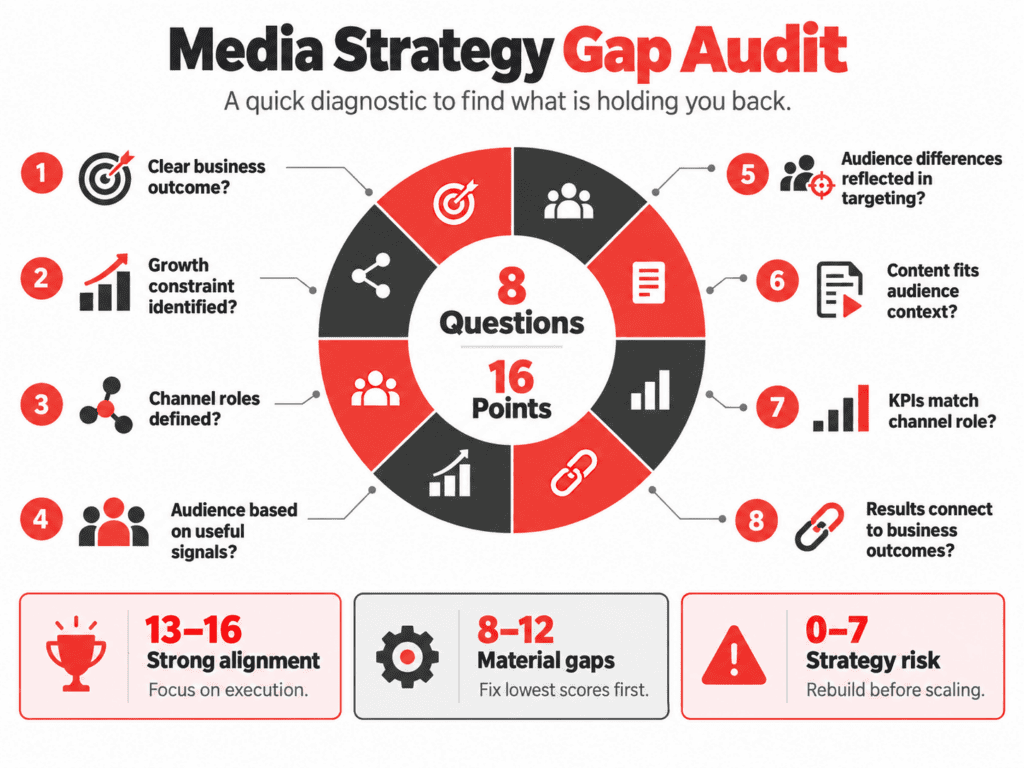
Score each question from 0 to 2.
A score of 0 means absent or unclear.
A score of 1 means partially defined.
A score of 2 means clearly defined and operational.
Question 1: Is the desired business outcome clearly defined?
Question 2: Has the primary growth constraint been identified?
Question 3: Does each major channel have a specific job?
Question 4: Is the audience based on useful business or intent signals?
Question 5: Are meaningful audience differences reflected in targeting?
Question 6: Does content reflect customer context and intent?
Question 7: Are channel KPIs appropriate to each channel’s role?
Question 8: Can campaign results be connected to meaningful business outcomes?
Step 1: Calculate the Total Alignment Score
A score of 13 to 16 suggests strong strategic alignment.
The foundation appears coherent. Focus next on creative quality, conversion friction, saturation, auction economics, sales execution, or marginal efficiency.
A score of 8 to 12 suggests material alignment gaps.
Several strategic assumptions may be limiting performance. Prioritize the lowest-scoring areas before adding substantial budget.
A score of 0 to 7 suggests structural strategy risk.
The campaign may be optimized around incomplete or conflicting assumptions. Platform-level adjustments alone are unlikely to solve the full problem.
Step 2: Identify the Failure Type
The total score tells you how aligned the strategy is.
The pattern of low scores tells you what kind of problem you have.
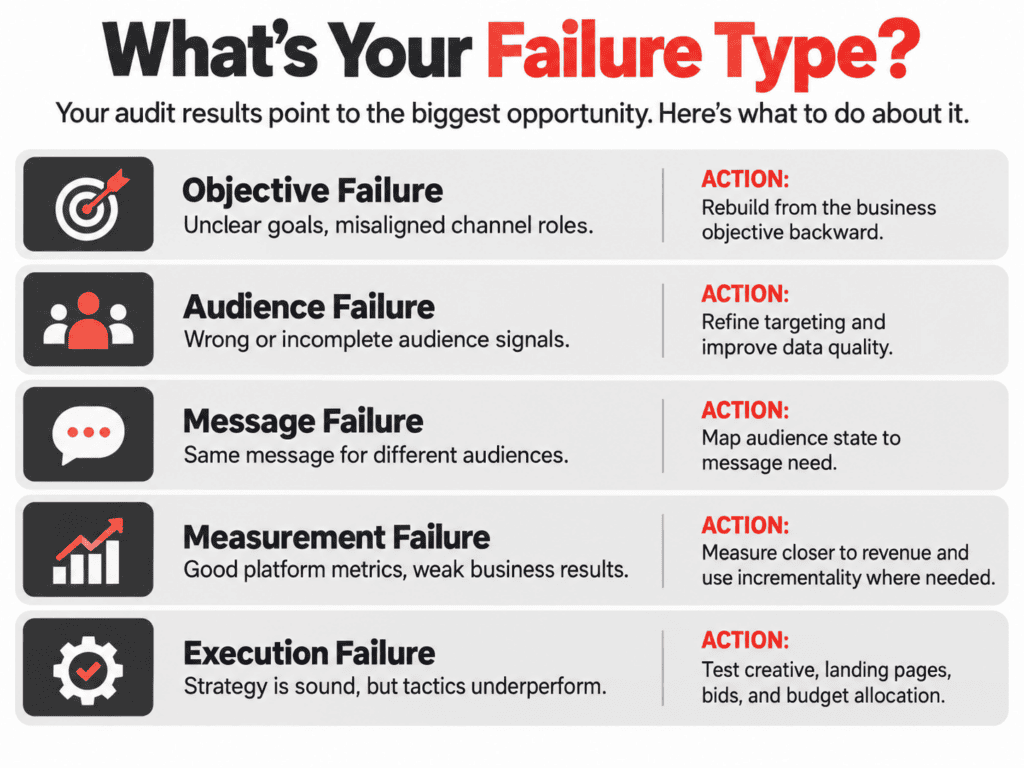
Failure Type 1: Objective Failure
Objective failure usually appears when scores are low for business outcome, growth constraint, and channel role.
Typical symptoms include teams disagreeing on what success means, budget allocation based on historical habit, every channel being expected to generate direct conversions, or leadership asking for more leads without defining lead quality.
The recommended action is to rebuild the strategy from the business objective backward.
Define the growth constraint first.
Then assign each channel one primary job.
Failure Type 2: Audience Failure
Audience failure usually appears when scores are low for business signals and audience differentiation.
Typical symptoms include lead volume improving while sales quality falls, targeting that is primarily demographic, first-party data that is available but not incorporated, or customers with different economic value being treated as equivalent.
The recommended action is to identify the signals that distinguish valuable customers from low-value conversions.
Improve CRM feedback, exclusions, qualification signals, and audience structure before adding budget.
Failure Type 3: Message Failure
Message failure usually appears when scores are low for content relevance and audience differentiation.
Typical symptoms include multiple audience segments seeing nearly identical creative, acceptable click-through rates with weak conversion, ads communicating features before buyers understand the problem, or remarketing repeating the same message prospects already ignored.
The recommended action is to map audience state to message need.
Change proof, offer, call to action, and creative depth based on customer context.
Failure Type 4: Measurement Failure
Measurement failure usually appears when scores are low for KPI fit and connection to business outcomes.
Typical symptoms include strong platform metrics with disappointing revenue, upper-funnel channels looking inefficient in last-click reporting, low-cost leads failing to become customers, or channels being compared with metrics that do not reflect their roles.
The recommended action is to move measurement closer to business value.
Incorporate qualified lead data, offline conversions, revenue, or customer value where practical.
Use incrementality testing when attribution alone cannot answer the decision.
Failure Type 5: Execution Failure
Execution failure can appear even when strategy scores are high.
Typical symptoms include creative fatigue, weak landing-page performance, poorly managed bids or budgets, constrained reach, or unresolved conversion friction.
In that situation, keep the strategy stable while testing execution variables.
This is where creative testing, landing-page improvements, platform optimization, and bid or budget changes are most likely to help.
Step 3: Fix the Lowest-Confidence Assumption First
The most useful question after the audit is not:
What should we optimize next?
It is:
Which important assumption do we have the least evidence for?
That may be whether a target audience is actually more valuable.
It may be whether a creative message is relevant.
It may be whether a channel adds incremental reach.
It may be whether a conversion event predicts revenue.
It may be whether a landing-page problem is suppressing performance.
The next test should reduce uncertainty around that assumption.
That turns the audit from a scorecard into a decision tool.
Stop Confusing Platform Performance With Business Performance
Advertising platforms optimize toward the events marketers give them.
That creates a basic rule:
The closer the optimization signal is to the real business outcome, the more commercially useful the learning can become.
Consider a lead-generation company.
A click is one possible signal.
A landing-page visit is another.
A form submission is deeper.
A qualified lead is more meaningful.
An opportunity is more meaningful still.
A sale or customer revenue may be closest to the true business outcome.
Moving deeper into the funnel usually increases business relevance.
It also reduces event volume and may introduce CRM, attribution, or data-quality challenges.
There is no universal point at which every company should optimize.
The decision depends on conversion volume, sales cycle length, data reliability, signal frequency, offline tracking quality, and differences in customer value.
The objective is to avoid optimizing toward a convenient proxy when that proxy stops representing the business outcome.
Incrementality Matters More Than Efficiency Alone
One of the hardest questions in media strategy is whether advertising caused additional business or simply received credit for demand that already existed.
A campaign can show a strong ROAS and still have low incrementality.
A channel can show a higher CPA while reaching customers who would not otherwise have converted.
Marketing leaders should distinguish between attributed performance and incremental performance.
Attributed performance is what the reporting system credits to a channel.
Incremental performance is what happened because the marketing investment existed.
The difference matters most when evaluating tactics such as branded search, retargeting, existing customer campaigns, affiliate activity, and other high-intent media.
Where spending levels justify it, incrementality tests, holdouts, geo experiments, media mix modeling, and other causal methods can help separate credited revenue from caused revenue.
When Should You Change the Media Mix?
Change the media mix when evidence suggests the current mix cannot perform the jobs required by the strategy at an acceptable marginal cost.
One reason may be that critical audiences cannot be reached efficiently.
Another may be that additional reach is becoming disproportionately expensive.
Audience saturation may be increasing.
A channel may not fit the customer journey.
Customer behavior may have changed.
Marginal returns may be deteriorating.
A stage of the buying journey may be unsupported.
Too much budget may be concentrated in demand capture.
Another channel may offer incremental reach or demand.
Weak overall campaign performance is not enough evidence on its own.
Before moving budget, determine whether the actual problem is channel selection, audience quality, creative, offer, conversion experience, measurement, attribution, sales follow-up, or market conditions.
Example: When Paid Search Works but Cannot Scale
Search is powerful because it reaches people expressing intent.
That strength also creates a limit.
Search cannot create unlimited demand for itself.
If a company captures most available high-intent search volume, additional spending may produce diminishing returns.
At that point, growth may require media that reaches qualified customers before they search.
The correct conclusion is not “search stopped working.”
It is:
The business needs another part of the media system to create additional demand.
How Do You Know Whether the Problem Is Media, Targeting, or Creative?
Performance data provides clues, not definitive diagnoses.
High reach with little response may point to weak message relevance, audience quality, or demand.
Strong click-through rate with weak conversion may point to landing-page friction, offer weakness, or expectation mismatch.
Rising frequency with falling response may indicate creative fatigue or audience saturation.
More leads with lower qualification may point to targeting or the conversion signal.
Efficient search with limited scale may point to insufficient existing demand.
Strong engagement with weak revenue may indicate a low-value audience or weak conversion path.
Upper-funnel media that looks poor in last-click reporting may indicate a measurement problem rather than a media problem.
Improving CPA while revenue quality falls may indicate optimization toward the wrong event.
Treat each pattern as a hypothesis.
The best next step is a test capable of distinguishing among competing explanations.
Prioritize Media Problems by Business Impact
Marketing teams can spend enormous effort optimizing variables that are easy to change but economically unimportant.
A simple prioritization model helps prevent that.
Score each suspected problem from 1 to 5 on three factors.
The first is business impact.
How much could fixing the issue affect revenue, CAC, pipeline, enrollment, or another core outcome?
The second is confidence.
How strong is the evidence that this is actually limiting performance?
The third is testability.
How quickly can the hypothesis be tested without introducing major ambiguity?
Then calculate:
Priority Score = Business Impact × Confidence × Testability
For example, a lead-quality problem might score 5 for impact, 4 for confidence, and 4 for testability.
That produces a priority score of 80.
A possible creative-color issue might score 2 for impact, 2 for confidence, and 5 for testability.
That produces a score of 20.
The model is deliberately simple.
Its purpose is to shift attention from “What can we optimize?” to “What is most worth learning next?”
Budget Decisions Should Be Based on Marginal Return
Average performance can obscure what happens to the next dollar invested.
Suppose a channel generated $1 million in attributed revenue from $200,000 in media.
That historical 5:1 return does not mean the next $100,000 will generate another $500,000.
As spend rises, cheaper impressions may disappear.
Audience saturation may increase.
Lower-intent prospects may enter the campaign.
Conversion rates may fall.
Incremental reach may become more expensive.
Marketing leaders should therefore evaluate marginal performance, not just average performance.
The more useful budgeting question is:
What return do we expect from the next dollar in this channel compared with the next dollar available elsewhere?
That reframes media planning from static allocation to capital allocation.
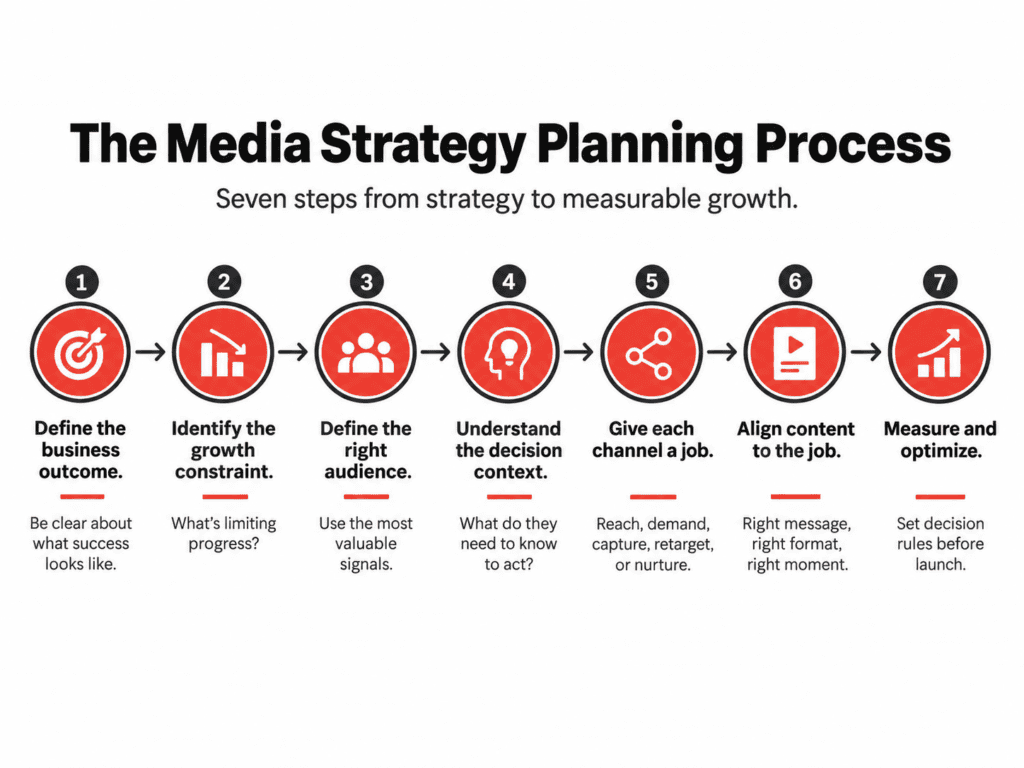
A Practical Media Strategy Planning Process
Step 1: Define the Business Outcome
Be specific.
The outcome might be acquiring qualified customers within a target CAC, increasing enrollment in priority programs, growing pipeline from a target account segment, increasing revenue in selected markets, or creating demand for a new product category.
Step 2: Identify the Growth Constraint
Determine what currently prevents that outcome.
Is the business short on awareness, demand, qualified traffic, conversion, lead quality, or retention?
Step 3: Define the Audience Capable of Changing the Outcome
Use the most valuable available evidence.
That may include customer data, sales data, research, behavioral signals, geography, intent, lifecycle stage, and purchase history.
Step 4: Understand the Decision Context
Identify what the audience needs to understand before acting.
What problem are they trying to solve?
What alternatives are they considering?
What prevents action?
What proof reduces uncertainty?
What matters economically or emotionally in the decision?
Step 5: Give Each Channel a Job
Every meaningful media investment should have a purpose.
That purpose may be building reach, generating demand, capturing intent, retargeting, nurturing, or supporting retention.
A channel that cannot explain its job should have difficulty defending its budget.
Step 6: Align Content to the Job and Audience
Match format, message depth, evidence, offer, call to action, and landing experience to the customer’s context.
Step 7: Define Measurement and Decision Rules
Before launch, document the primary business outcome, leading indicators, primary KPI, diagnostic metrics, attribution approach, test variables, optimization cadence, and budget reallocation criteria.
That makes optimization less reactive and more useful.
What Should You Expect From a Media Strategy Partner?
A media partner should be able to explain more than where the budget is going.
The agency should be able to explain why each channel is in the plan.
It should be able to identify which audience each channel is designed to reach.
It should explain what role each channel plays in the customer journey.
It should explain why the creative fits that role.
It should show what metric determines success and how that metric connects to business performance.
It should be able to state what assumption is being tested.
It should know what evidence would justify changing the strategy, increasing spend, or reducing spend.
These questions separate strategic media management from platform administration.
A strong partner should also challenge the premise when the requested media tactic does not address the actual business problem.
That may mean recommending a different channel.
It may mean improving measurement before increasing budget.
It may mean narrowing geographic scope.
It may mean broadening targeting.
It may even mean concluding that media is not the primary constraint.
Trust is built when the recommendation follows the evidence rather than the available inventory.
Why Media Strategy Matters More as Advertising Becomes Automated
Advertising platforms increasingly automate bidding, placements, audience expansion, budget allocation, creative variation, and conversion prediction.
This reduces some of the tactical effort required to execute campaigns.
It does not eliminate strategic decisions.
Platforms still do not automatically know which customers are most profitable.
They do not know which leads sales considers qualified.
They do not know which regions matter most.
They do not know which products have excess capacity.
They do not know which customer segments retain longer.
They do not know which revenue should be considered incremental.
They do not know which business problem leadership needs marketing to solve.
Those decisions require business context.
As media execution becomes more automated, competitive advantage shifts further toward better inputs, better strategy, better measurement, and better decisions about what the system should optimize.
Frequently Asked Questions About Media Strategy
What Are the Most Common Media Strategy Mistakes?
Common media strategy mistakes include starting with channels rather than business objectives, optimizing toward low-value conversion signals, defining audiences without reference to customer value, using the same content across materially different audience states, evaluating every channel with the same KPI, and moving budget before diagnosing why performance changed.
How Do You Know If Your Media Mix Is Wrong?
A media mix may need to change when important audiences cannot be reached efficiently, marginal returns are declining, frequency is increasing without incremental results, a critical stage of the buying journey is unsupported, or the plan depends too heavily on capturing demand that already exists.
Poor overall performance does not automatically mean the mix is wrong.
How Specific Should Audience Targeting Be?
Audience targeting should be specific enough to reflect important business constraints and customer differences without unnecessarily limiting platform learning.
Use business information the platform may not know, such as qualified lead status, first-party customer data, geography, product eligibility, purchase behavior, and customer value.
How Should Content Strategy Influence Media Planning?
Content strategy should determine what different audiences need to hear based on intent, awareness, objections, and buying context.
Media planning determines how those audiences can be reached.
When media and content are planned together, targeting determines not only who sees the advertising but also which message is most appropriate.
Should Media Campaigns Optimize for Leads or Revenue?
Optimize as close to the real business outcome as data quality and conversion volume allow.
Lead volume can be a useful signal, but it can also encourage platforms to find inexpensive low-quality leads.
Where possible, incorporate qualified leads, opportunities, purchases, enrollment, revenue, or customer value into media decision-making.
How Often Should a Media Strategy Be Reviewed?
Review campaign performance continuously, but change the underlying strategy when meaningful evidence changes.
That may include shifts in customer behavior, marginal efficiency, product priorities, conversion quality, market conditions, business objectives, or channel economics.
What Should You Ask a Media Planning Agency Before Hiring It?
Ask how the agency connects media spending to business outcomes.
Ask how it determines channel roles.
Ask how it evaluates audience quality.
Ask how it measures incrementality.
Ask how it uses first-party data.
Ask how it aligns creative with targeting.
Ask how it allocates incremental budget.
Ask what would cause it to recommend that a client spend less.
The answers reveal whether the agency is focused primarily on buying media or improving business performance.
The Media Problem May Not Be a Media-Buying Problem
When campaigns underperform, changing platforms is one of the easiest responses to see.
Strategic misalignment is harder to identify.
You may have the right channels and the wrong audience.
You may have the right audience and an irrelevant message.
You may have strong creative but optimize toward a conversion event that has little relationship to revenue.
You may have efficient lower-funnel campaigns that capture demand while doing little to create the next wave of customers.
Or you may be evaluating an effective channel with a measurement model that cannot see its contribution.
The solution is to evaluate media as a connected business system.
Start with the outcome.
Identify the constraint.
Define the audience.
Assign every channel a job.
Build content around customer context.
Measure results as close to economic value as practical.
Then test the assumptions that matter most.
As advertising execution becomes more automated, these decisions become more important.
The advantage will not necessarily go to the company using the most channels, the narrowest targeting, or the most sophisticated platform features.
It will go to companies that create the clearest connection between business strategy, audience understanding, content, media investment, and measurable economic outcomes.
Ready to partner with a full-service agency that consistently delivers great results for our clients? Colling Media will help you close your gaps and turn your failures into wins that drive real gains on revenue, cost-per-lead, and more.
Fill out a form or give us a call today!