

Choosing a full-service media agency is not primarily about finding a company that can buy the most channels.
Most established agencies can manage paid search, paid social, programmatic advertising, connected TV, streaming audio, traditional television, radio, or out-of-home media in some combination.
The harder question is whether the agency can make those channels work together.
A strong full-service media agency should be able to explain what business problem the media plan is solving, which audiences matter, what role each channel plays, how creative changes across the customer journey, how budgets will move, and how performance connects to meaningful business outcomes.
That distinction matters because an agency can manage many platforms and still operate them as separate campaigns.
At Colling Media, we think the better test is whether the agency can turn those channels into one accountable media system.
If you are comparing full-service media agencies, this guide will help you evaluate the areas that matter most before making a decision.
What Is a Full-Service Media Agency?
A full-service media agency plans, buys, manages, measures, and optimizes advertising across multiple channels while coordinating those channels around a shared business strategy.
That can include both digital and traditional media.
Digital channels may include paid search, paid social, programmatic display, connected TV, streaming video, and streaming audio.
Traditional media may include linear television, radio, and out-of-home advertising.
The important distinction is not simply whether an agency can access these channels.
It is whether the agency can explain why each one belongs in the plan.
Full-Service Media Agency vs. Digital Agency
A digital agency focuses primarily on online marketing channels.
A full-service media agency can take a broader view by planning across both digital and traditional media when the customer journey requires it.
Neither model is automatically better.
A digital specialist may be the right choice if your opportunity is concentrated in a small number of online channels and your internal team already owns strategy, analytics, integration, and budget allocation.
A full-service media agency becomes more valuable when customers move across multiple environments and someone needs to coordinate those touchpoints.
A prospective customer may first see a television or connected TV ad, later search for the brand, visit the site, receive a retargeting impression, and eventually convert through paid search.
If each channel is managed separately, the business may understand individual campaign performance without understanding how the full journey worked.
That is where integrated media planning matters.
The First Test: Can the Agency Plan Media Before It Buys Media?
One of the most important questions to ask a full-service media agency is simple:
Why is each channel in the plan?
A credible answer should go well beyond statements such as “CTV builds awareness” or “search drives leads.”
The agency should first understand the business outcome.
Then it should identify what is preventing that outcome, define the audience, assign each channel a role, determine the message needed at different stages, choose the right measurement approach, and establish the conditions that would justify changing the investment.
A strong media plan should follow a logic similar to this:
Business objective → growth constraint → audience → customer journey → channel role → message → KPI → budget decision
If the agency jumps directly from “we need growth” to a list of platforms, too much strategic work has been skipped.
At Colling Media, this is one of the patterns we see most often when reviewing underperforming media programs.
A media plan can become a channel list before the business problem has been fully defined. The more channels added to that plan, the more expensive the original mistake can become.
How Should You Evaluate Media Planning Quality?
A strong full-service media agency should be able to defend the logic behind the plan.
Ask why a specific channel is included.
Ask which audience it is intended to influence.
Ask what job that channel performs better than the alternatives.
Ask what would cause the agency to move money away from it.
Ask how the proposed budget was determined.
These questions matter because media plans can look polished even when the underlying logic is weak.
A recommendation that includes search, paid social, programmatic, and connected TV may appear comprehensive.
But if all four channels are expected to “generate leads,” the plan may not actually define different roles.
Search may capture existing demand.
Connected TV may build awareness.
Programmatic may support consideration.
Paid social may do some combination of prospecting, demand creation, and retargeting.
If channels perform different jobs, they should not necessarily be judged by the same KPI.
The agency should be able to make those distinctions clear before launch.
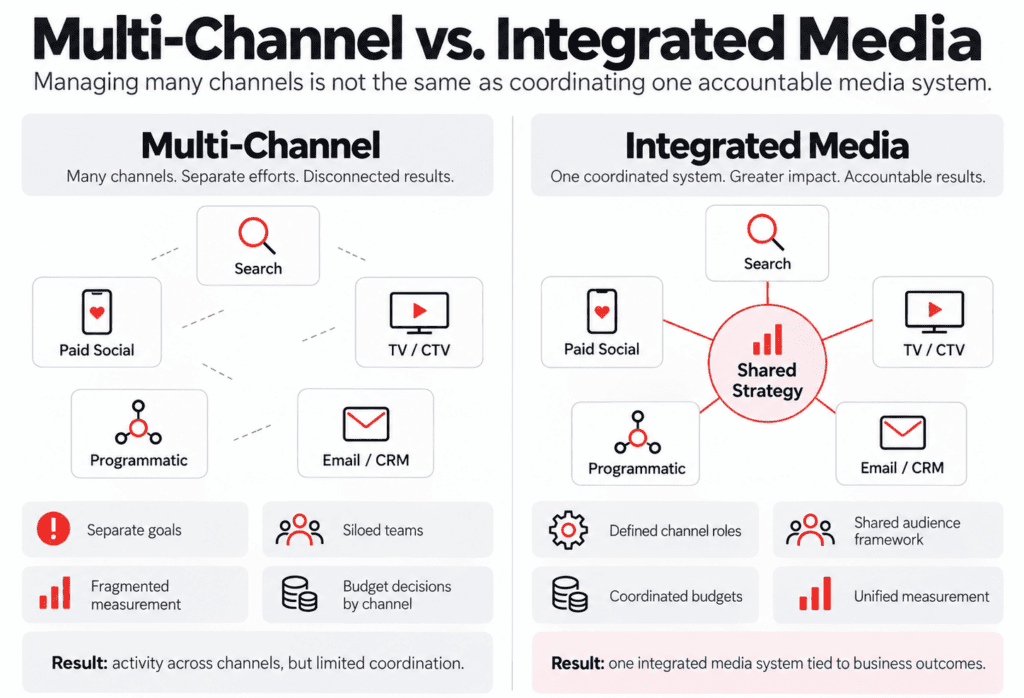
Multi-Channel Is Not the Same as Integrated Media
This is one of the most important differences to understand when comparing agencies.
Multi-channel media means a company uses several advertising channels.
Integrated media means those channels are coordinated around a shared audience, customer journey, message strategy, business objective, and measurement framework.
An agency can be multi-channel without being integrated.
One department may manage paid search.
Another may handle paid social.
A third may buy television.
A fourth may manage programmatic.
If those teams have separate goals, audience assumptions, reporting systems, and budgets, the client may have consolidated agency relationships without consolidating strategy.
At Colling Media, we see this distinction as one of the biggest differences between buying media in multiple places and managing an integrated media program.
Channel integration is often claimed because one agency manages multiple platforms. That is operational consolidation. Strategic integration begins when every channel has a defined role in the same customer journey.
How Can You Tell Whether Digital and Traditional Media Are Really Integrated?
Ask the agency to explain a customer journey that crosses both.
Suppose a customer sees a television ad on Monday.
On Wednesday, that person searches for the company and visits the website.
On Friday, the customer receives a retargeting display ad.
On Saturday, the customer searches again, clicks a paid search ad, and converts.
Last-click reporting may assign the conversion to paid search.
That does not necessarily mean paid search created the demand.
No measurement system provides perfect certainty across every offline and online interaction.
A trustworthy agency should acknowledge that.
The important question is whether it has a disciplined method for getting closer to the real answer.
A Useful Test for Integration: Can the Agency Explain the Whole Customer Journey?
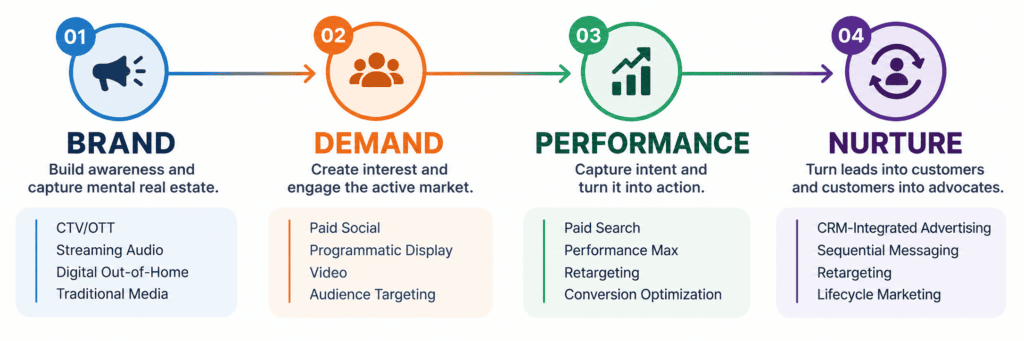
At Colling Media, we use the BDPN Framework to make channel roles explicit.
BDPN stands for Brand, Demand, Performance, and Nurturing.
The framework organizes media around stages of the customer journey rather than treating channels as independent campaigns.
Brand
Brand activity creates awareness before someone is actively shopping.
The goal is to enter the consideration set early.
Channels may include linear television, connected TV, programmatic audio, and digital out-of-home.
Demand
Demand activity engages people who are moving into the market and beginning to consider their options.
That can include programmatic display, video, and targeted paid social.
Performance
Performance activity captures high intent and drives direct action.
This can include paid search, retargeting, and conversion-focused campaigns.
Nurturing
Nurturing continues the relationship after the initial inquiry, conversion, application, or purchase.
This may include CRM-driven media, email, or sequential messaging.
The buyer takeaway is not that every company needs to use Colling Media’s framework.
It is that a full-service media agency should be able to show where each channel fits in the customer journey and why the metric used to evaluate that channel matches the job it performs.
At Colling Media, BDPN is how we make that logic explicit.
Does the Agency Connect Brand and Performance?
Many companies evaluate brand media and performance media separately.
That can create a false choice.
Brand activity can create awareness and future demand.
Performance activity captures existing intent.
Both can matter.
The problem occurs when one side is evaluated with the measurement model of the other.
If a connected TV campaign is judged only by direct cost per lead, it may appear inefficient because much of its value occurs before the customer searches.
If paid search is judged only by attributed ROAS, it may appear to create more demand than it actually does because it often sits close to the conversion.
When evaluating an agency, ask how it connects brand and performance rather than asking which one it prefers.
A sophisticated agency should be able to explain when each deserves investment and how the two affect one another.
Does the Agency Measure Business Outcomes or Media Activity?
This is where many agency relationships become difficult.
Marketing platforms produce enormous amounts of data.
That does not mean the client gets business insight.
An agency may report impressions, clicks, CTR, CPC, CPM, video completion rate, conversion rate, and cost per lead.
Those metrics can be useful.
None automatically proves that the media investment improved the business.
For a lead-generation business, the meaningful sequence may look more like this:
A click becomes a website visit.
A visit becomes a lead.
A lead becomes a qualified lead.
A qualified lead becomes an opportunity.
An opportunity becomes a sale.
A sale becomes revenue.
The closer the agency can connect media performance to those later outcomes, the more useful its reporting becomes for executive decision-making.
A simple question to ask during an agency evaluation is:
What happens after the lead?
If the agency cannot answer, you may be buying platform optimization rather than business accountability.
Can the Agency Explain the Limits of Attribution?
This is another important trust test.
Attribution is not perfect.
Last-click attribution can overvalue lower-funnel channels because it gives credit to the final interaction before conversion.
Multi-touch attribution can provide a broader view, but it still depends on observable touchpoints and data quality.
Traditional media can be harder to measure directly.
An experienced agency should be able to explain which methods it uses, what those methods can show, and where uncertainty remains.
The goal is not to eliminate uncertainty.
The goal is to reduce enough uncertainty to make better budget decisions.
How Does the Agency Decide Where the Next Dollar Goes?
Media planning is ultimately a capital allocation problem.
That means average historical performance is not enough.
Suppose a channel generated $1 million in revenue from $200,000 in media.
That 5:1 historical return does not guarantee that the next $100,000 will produce another $500,000.
As investment rises, the agency may encounter higher media costs, audience saturation, lower-intent users, or weaker conversion rates.
The more important budgeting question is:
What return do we expect from the next dollar in this channel compared with the next dollar available elsewhere?
Ask the agency how it thinks about marginal performance.
Ask what evidence would cause it to move money.
Then ask one of the most revealing questions in an agency review:
What would cause you to recommend that we spend less?
An accountable agency should be as comfortable recommending less spend as more spend when the economics do not justify additional investment.
Who Actually Owns the Strategy?
A full-service agency can look integrated in a pitch deck while remaining highly siloed in practice.
That is why buyers should understand the operating model.
Who develops the media strategy?
Who manages digital channels?
Who buys traditional media?
Who owns analytics?
Who connects sales or CRM data to media decisions?
Who decides when budget should move between channels?
Who is accountable when the data from two channels appears to conflict?
These questions reveal how the agency actually works.
An agency can be full-service structurally while remaining siloed operationally.
The strongest agency relationships usually have clear strategic ownership across disciplines rather than requiring the client to reconcile competing recommendations from separate channel teams.
How Transparent Is the Agency About Fees, Data, and Ownership?
Agency pricing structures vary.
Some use retainers.
Some charge a percentage of media.
Some use project fees or hybrid models.
There is no single fee model that is correct for every business.
Transparency matters more.
Before hiring a full-service media agency, understand what is included in the media budget and what sits outside it.
Understand technology fees, production costs, data costs, platform charges, and agency compensation.
Also clarify who owns the advertising accounts, audience data, reporting access, creative assets, and historical performance data.
The buyer should understand both what the agency costs and how the compensation model could influence recommendations.
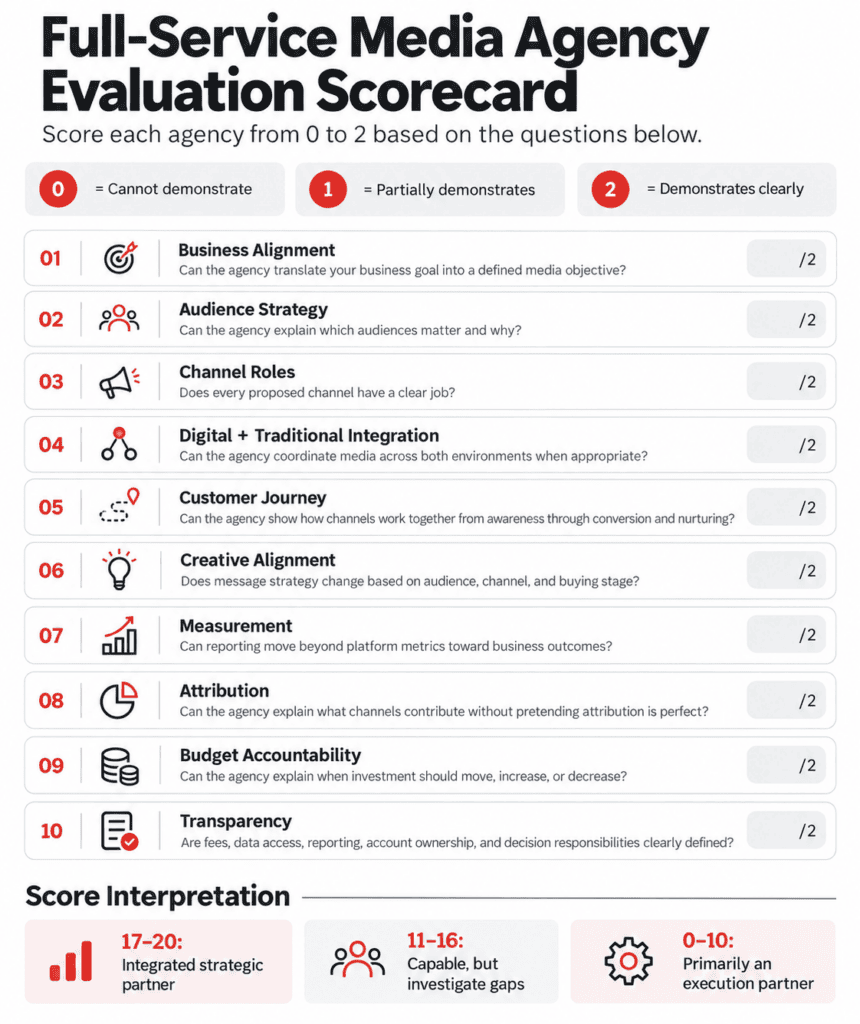
The Full-Service Media Agency Evaluation Scorecard
A buyer should not choose an agency based on a single pitch meeting.
A simple evaluation scorecard can make comparisons more disciplined.
Score each agency from 0 to 2 across ten areas.
A score of 0 means the agency cannot clearly demonstrate the capability.
A score of 1 means it demonstrates the capability partially.
A score of 2 means it demonstrates the capability clearly and can show how it works in practice.
Business Alignment
Can the agency translate your business goal into a defined media objective?
Audience Strategy
Can the agency explain which audiences matter and why?
Channel Roles
Does every proposed channel have a clear job?
Digital and Traditional Integration
Can the agency coordinate media across both environments when appropriate?
Customer Journey
Can the agency show how channels work together from awareness through conversion and nurturing?
Creative Alignment
Does message strategy change based on audience, channel, and buying stage?
Measurement
Can reporting move beyond platform metrics toward business outcomes?
Attribution
Can the agency explain what channels contribute without pretending attribution is perfect?
Budget Accountability
Can the agency explain when investment should move, increase, or decrease?
Transparency
Are fees, data access, reporting, account ownership, and decision responsibilities clearly defined?
A total score of 17 to 20 suggests the agency appears capable of operating as an integrated strategic partner.
A score of 11 to 16 suggests a capable agency with areas that deserve additional investigation.
A score of 0 to 10 suggests the agency may be better suited to execution than to owning the broader media strategy.
The score is not a substitute for judgment.
Industry expertise, team chemistry, geographic needs, internal capabilities, organizational complexity, and scale still matter.
Use the scorecard to expose the questions that need better answers.
Full-Service Agency vs. Specialist Agency: Which Is Better?
A full-service agency is not always the right choice.
A specialist can make sense when the problem is narrow and clearly defined.
If your internal team already owns strategy, measurement, creative integration, and budget allocation, hiring a specialist for one complex channel can be highly effective.
A full-service media agency becomes more useful when the challenge is coordination.
That includes situations where customers move across many media environments, traditional and digital channels need to work together, multiple agencies are creating silos, leadership wants consolidated accountability, or budget decisions need to be made across the entire media portfolio.
The decision is less about agency size and more about where your organization needs strategic ownership.
Warning Sign: Every Channel Uses the Same KPI
Different media roles require different success measures.
A channel designed to create awareness should not necessarily be judged by the same immediate CPA target as high-intent search.
If an agency forces every channel into the same metric, ask whether it has defined distinct roles across the journey.
Warning Sign: The Pitch Is Mostly About Platforms
Technology matters.
Platform expertise matters.
But the tools should follow the strategy.
If most of the agency pitch is about platform features and very little is about the client’s business constraints, audience, economics, and customer journey, the agency may be more comfortable executing media than solving the underlying growth problem.
Warning Sign: Traditional and Digital Teams Rarely Interact
This may indicate that you are buying multiple campaigns under one agency name rather than an integrated media system.
Ask how the teams plan together, share data, and make budget decisions across channels.
Warning Sign: Reporting Ends at the Lead
Lead volume is not the same as business performance.
If the agency cannot incorporate qualification, sales, enrollment, purchase, revenue, or another deeper outcome, it may optimize toward a signal that is convenient rather than valuable.
Warning Sign: More Budget Is the Default Answer
Sometimes the right answer is to spend more.
Sometimes it is to move budget.
Sometimes it is to improve measurement, targeting, creative, conversion experience, or sales follow-up before adding another dollar.
An agency that treats more media as the default solution has an obvious incentive problem.
What Should a Full-Service Media Agency Be Accountable For?
A full-service media agency should be accountable for the quality of its media strategy, the logic behind channel selection, audience strategy, budget allocation, execution, optimization, measurement, and recommendations.
It should also be transparent about what it does not control.
The agency cannot independently control pricing, product availability, sales execution, customer service, market conditions, or operational capacity.
Accountability does not mean claiming responsibility for every business outcome.
It means clearly defining which decisions the agency owns, measuring those decisions rigorously, and changing course when the evidence does not support the current plan.
What Should You Ask a Media Agency Before Hiring It?
Ask how it decides which channels belong in the plan.
Ask how traditional and digital media work together.
Ask how it evaluates brand-building media.
Ask what its attribution model can and cannot measure.
Ask how it uses first-party customer data.
Ask whether it can connect leads to revenue or other downstream outcomes.
Ask how it determines when budget should move.
Ask what would cause it to recommend spending less.
Ask who owns the advertising accounts and data.
Ask how you will know, six months into the relationship, whether the agency is improving the business.
The answers will tell you far more than the capabilities page.
How Colling Media Thinks About Full-Service Media
Colling Media was built around the idea that media should be accountable to business results, not just platform activity.
Our approach combines digital advertising, traditional media, media planning and buying, analytics, advertising strategy, and attribution.
We use the BDPN® Framework to assign Brand, Demand, Performance, and Nurturing distinct roles in the customer journey rather than treating them as disconnected campaigns.
We also use analytics and attribution to help clients understand how media works across touchpoints rather than relying only on the last interaction before conversion.
For us, full-service does not mean putting more services on a capabilities page. It means being accountable for how those services work together.
That is the standard we think buyers should use when comparing agencies.
Frequently Asked Questions About Full-Service Media Agencies
What Does a Full-Service Media Agency Do?
A full-service media agency plans, buys, manages, measures, and optimizes advertising across multiple channels. The strongest agencies also coordinate those channels around a shared business objective, audience strategy, customer journey, and measurement framework rather than managing each channel independently.
What Is the Difference Between a Media Agency and a Digital Marketing Agency?
A digital marketing agency primarily focuses on online channels. A full-service media agency may plan across both digital and traditional media. The better choice depends on how your customers behave and how much strategic integration your internal team can manage.
Should One Agency Manage Both Traditional and Digital Media?
One agency can be valuable when customers move across both environments and the business wants coordinated planning, measurement, and budget allocation. The advantage only exists if the agency actually integrates the strategy.
How Do You Evaluate a Media Planning Agency?
Evaluate whether the agency connects business objectives to audience strategy, channel roles, creative, measurement, and budget decisions. Ask why each channel belongs in the plan, how success will be measured, how money will move, and what evidence would cause the agency to change its recommendation.
What Should a Media Agency Include in Its Reporting?
Reporting should include channel performance, but it should move as close to business outcomes as the available data allows. Depending on the company, that may include qualified leads, opportunities, sales, enrollments, revenue, customer acquisition cost, retention, or lifetime value.
How Much Should a Full-Service Media Agency Cost?
There is no universal fee structure. Agencies may charge retainers, a percentage of media, project fees, or hybrid compensation. The more important issue is transparency around agency fees, media spend, technology costs, production costs, data fees, and other charges.
Is a Full-Service Agency Better Than a Specialist Agency?
Not always. A specialist can be the better option when the problem is narrow and the client already owns strategy and integration internally. A full-service media agency becomes more valuable when the business needs one partner to coordinate audiences, channels, creative, measurement, and budget decisions across the customer journey.
Choose the Agency That Can Explain Why the Investment Exists
The number of channels on a capabilities slide should not determine which full-service media agency you hire.
The more important questions are harder.
Why is each investment being made?
Who is the media intended to influence?
What role does each channel play?
How will digital and traditional media reinforce one another?
How will the agency connect performance to business outcomes?
What evidence will determine where the next dollar goes?
And what will the agency do when the evidence contradicts the original plan?
Those questions reveal whether an agency is primarily selling media execution or providing strategic media leadership.
The strongest full-service media partner is not the agency that can buy everything. It is the agency that can explain why each investment exists, how it supports the customer journey, and what evidence determines what happens next.
If you’re ready to work with a full-service agency that has a track record of boosting ROAS, lowering cost per lead, and driving conversions, then you should partner with Colling Media. Fill out a form or give us a call today!